
AI-Native Organizations: How Carbon-Based Bosses Arrange Collaboration Between Silicon-Based and Carbon-Based Employees

Over the past couple of years, I’ve chatted with quite a few bosses in manufacturing and factory operations, and the conversation always circles back to the same question: how exactly do you put AI to work inside a company?
Most people’s first instinct is still “buy a tool.” Get an AI customer service bot, spin up a large language model, have IT hook up an API—save some manpower where you can. But once it’s actually in use, you realize: sure, you bought the tool, but the work hasn’t shrunk much, and employees have to learn how to babysit it on top of everything else.
The root of the problem isn’t the tool—it’s the organization. The organizational form we’re used to is “human + tool”—the human is the protagonist, the tool is an extension of their hands. But an AI-native organization thinks about it differently: the human is still the protagonist, but AI isn’t a tool—it’s an employee. It has its own role, its own work, and its own boundaries.
So here’s the question: a boss now has two kinds of employees—carbon-based (real people) and silicon-based (AI agents). How do you position them? How do you divide the work? Who’s accountable when something goes wrong? That’s what this article is about.
· · ·
1Let’s get one thing straight: what is an “AI-native organization”?
The term “AI-native” gets thrown around a lot these days. Let me put it in plain terms.
Traditional digitalization follows the logic of “moving offline processes online”—humans execute, systems record. AI-native flips that: many execution steps can be handed off to AI agents, while humans step back to the position of “setting goals, making judgments, and taking responsibility.”
Here’s a concrete example. When a customer sends a drawing for a quote, the old process was roughly: salesperson receives it → forwards to engineering → engineering calculates materials → quote → send back to customer. Every step needed a person.
An AI-native approach now looks like this: the salesperson drops the request into a “quoting agent,” which reads the drawing, pulls historical orders, estimates the rough material usage and cost range, and generates a draft quote. The human just reviews the draft, tweaks a couple of numbers, and hits confirm to send it out.
The work is still the same work, but the subject doing the executing has changed. What used to be a string of people lined up along an assembly line is now one carbon-based employee leading a few silicon-based employees, compressing that assembly line into a small “human + agent” squad.
The basic unit of the organization has shifted from the “job position” to the “human + agent squad.”
2The carbon-based boss’s role has actually changed
For bosses, this shift is actually a bit counterintuitive.
In the past, a boss’s job was “managing people”: defining roles, headcount, KPIs, and watching to make sure people were actually working. Now there’s an extra layer—you’re not just managing carbon-based employees, you’re also managing silicon-based ones. And silicon-based employees are something you can’t really “manage.” They don’t slack off, they don’t complain to you. They only care about one thing: whether the goals, context, and permissions you give them are clear.
So I’d sum up the boss’s new role in three sentences:
From managing processes to managing intent. Before, you had to break processes down into fine detail and write them into SOPs; now, it’s more about clearly stating “what result do I actually want.”
From assigning tasks to designing collaboration. Work isn’t done just by handing it to someone—you need to design how humans and agents hand off to each other and how results get validated.
From stepping in personally to setting the rules. Which decisions must be made by a human, and which can be left to agents—the boss has to draw that line themselves.
Put simply, the boss’s focus is shifting from “pushing execution” to “designing the organization.”
3Who should do what: silicon-based vs. carbon-based?
This is the most practical question. My criterion is just one: does this task require “accountability” and “judgment”? If yes, keep it with humans. If not, hand it to agents wherever possible.
What’s suitable for silicon-based employees (AI agents)
▪ Repetitive, high-frequency work with standard answers. Like data entry, document verification, standard customer service Q&A.
▪ Information-processing work. Like reading through a pile of materials to produce a summary, digging through historical data to find patterns, or organizing scattered information into a table.
▪ Draft-producing work. Like writing a first-draft proposal, drafting a quote, or taking meeting minutes.
▪ 24/7 monitoring work. Like equipment alerts, order monitoring, nighttime inspections—humans can’t stay awake, but agents can.
▪ Work that requires “remembering massive amounts of information.” Like being able to pull up all communication records with a given customer over the past three years at any time.
What must stay with humans (carbon-based employees)
▪ Decisions that require accountability. Whether to sign this contract, whether to shut down this production line—the responsibility lies with a person, not AI.
▪ Matters that require relationships. Building rapport with customers, negotiating prices with suppliers, soothing team morale—AI is still far from capable here.
▪ Matters that require real judgment. When information is incomplete, situations are unusual, or on-the-spot trade-offs are needed, human experience is still valuable.
▪ Final calls on creativity and direction. AI can give you ten options, but a human still decides which one to pick.
I’m particularly fond of one line: AI is responsible for “getting things done,” while humans are responsible for “deciding whether to do it and whether it’s done right.”
4The collaboration mechanism: dispatch, handoff, validation
With the direction clear, next comes the concrete mechanism. Human-agent collaboration essentially comes down to three things: how to assign work, how to hand off, and how to validate.
Assigning work When a boss or manager receives a task, don’t rush to hand it out. First ask: which parts of this are “standard moves”? Cut the standard-move parts into tasks and assign them to the corresponding agents; keep the judgment-heavy and relationship-heavy parts for people. It’s normal for a job to be split into “an agent does a stretch, a person does a stretch”—don’t feel awkward about it.
Handoff Handoffs are where things go wrong most easily. When an agent finishes a job, there needs to be a delivery format “a person can understand”—not a pile of logs, but a result that can be used directly, ideally with clear notes on “what I did, what I based it on, and where I’m unsure.” When a person takes over, focus on that “unsure” part.
Acceptance Don’t skip this step. Work given to agents also needs acceptance criteria—it’s just that the boss sets the standards, and checks can be sampled or handed to another agent. The quality-inspection role can often be siliconized—have one agent specifically cross-check another agent’s output.
Once these three things run smoothly, human-agent collaboration is truly up and running. If they don’t, you get that awkward situation: an agent produces work no one dares to use, and a person has to redo it from scratch.
5 Write a “job description” for your silicon-based employee
Many people overlook this point, but it’s especially critical.
When you hire a carbon-based employee, you give them a job description: what they do, who they report to, how much authority they have. It’s the same with a silicon-based employee—you need to spell out three things:
1 Goal: What result is it actually responsible for. For example, “produce a credible draft quote within 5 minutes,” not “help handle inquiries.”
2 Context: What information it needs to know to do the job well. Customer data, order history, costing rules, company policies—these need to be fed to it, and they need to be clean and up to date.
3 Authority: What it can touch and what it can’t. Can it message customers directly? Can it change data in the system? This line must be clear, or sooner or later something will go wrong.
Once these three are clearly written, an agent is effectively “onboarded.” If they aren’t, it will always give you work that “looks about right but can’t actually be used.”
By the way, one very critical role—FDE, Forward Deployed Engineer. In AI implementation, what an FDE does is “translate the boss’s intent into tasks an agent can execute,” and “tune the agent’s boundaries into place.” This role is in especially short supply right now, because it requires understanding both the business and how to work with AI. Many factory AI projects fail not because AI doesn’t work, but because there’s no one who can stand in the middle and connect both sides.
6 What it looks like inside a factory
Let’s use a more realistic scenario.
A factory making non-standard parts; the boss wants to adopt AI. The traditional approach is to buy an MES, add AI quality inspection—the whole set costs hundreds of thousands to over a million, and employees have to relearn everything.
The AI-native approach might look like this: don’t roll out a big system first; instead, focus on a few of the most painful steps and equip a few agents.
Order intake A “quoting agent” reads drawings, digs through history, and produces a draft quote; the salesperson reviews it and sends it to the customer. A job that used to take 3 hours is compressed to 20 minutes.
Scheduling A “scheduling assistant” gives scheduling suggestions based on equipment status and delivery dates; the planner makes the call. The planner no longer has to crunch numbers in Excel for ages.
Quality inspection A “QC agent” looks at inspection data and flags anomalies; a person reviews. This person used to stare at a screen all day; now they only step in when there’s an alert.
Customer order tracking An “order-tracking agent” monitors order progress and proactively flags anomalies; the account manager only handles the parts that genuinely need a human touch.
You’ll notice the boss didn’t lay anyone off or add anyone—instead, everyone was “lifted up a level”: carbon-based employees’ work looks more like “reviewing, judging, making the call,” while the heavy execution work has been taken over by silicon-based employees.
This is what an AI-native organization looks like: people don’t necessarily become fewer, but what people do changes.
7 For implementation, what can AgentSteamer do for the boss
We’ve covered a bunch of principles: write job descriptions for agents, assign/hand off/accept work, draw clear human-machine boundaries. These ideas aren’t hard, but when a boss actually gets started, they often get stuck—where do you build an agent? How do several agents connect? How do you make them reach the company’s real orders and drawings? And how does the boss keep an eye on their boundaries?
This is exactly the problem AgentSteamer, as an agent platform, is meant to solve. Put simply, AgentSteamer turns that whole “how to manage silicon-based employees” idea into something a boss can actually operate. It mainly helps the boss do three things:
① Turn the “job description” into something you can actually configure
We said earlier that an agent needs clear goals, context, and authority. On AgentSteamer, these three are directly configurable—set its goal, attach the company’s knowledge (customer data, order history, costing rules), then define which tools it can use and which data it can touch. The boss or manager doesn’t need to write code; just like briefing a new employee, they can get an agent “onboarded.”
② Let one carbon-based employee lead a team of silicon-based employees
The assigning, handoff, and acceptance we talked about earlier are, on AgentSteamer, “multi-agent orchestration”: you can split a big task among several agents and let them hand off automatically and cross-check each other—for example, have one agent specifically check another’s output, and the quality-inspection role is conveniently siliconized. And the red line the boss sets—”a human must make the call”—can be set directly as a confirmation node in the workflow; when it reaches that step, a person must click confirm, and the agent can’t get past it.
③ Connect agents back to real business
This is where many AI projects crash: the agent floats in mid-air, can’t reach real orders, drawings, or customer records, and the work it produces naturally “looks about right but can’t actually be used.” AgentSteamer can connect to a company’s existing systems and data, so agents can read real material—and what they produce is work that can be used directly.
For a boss, the greatest value of using Mofu isn’t “having one more tool”—it’s that you can actually build the organizational form you want with it: which tasks go to silicon-based workers, which stay with humans, and which steps must be decided by a person—all of this can be configured and set running on the platform.
The FDE mentioned earlier—at this stage, their job also becomes concrete: translating the boss’s intent into sets of agent configurations, and tuning each agent’s boundaries into place. The tool makes the scaffolding work easier for you, but “thinking clearly about what kind of organization you want” is still something the boss has to do themselves.
8 A Few Things Bosses Can Do Right Now
After all this talk, when it comes to action, I suggest bosses start with these few things:
1. Don’t start with a big system—start with one or two of the most painful links. Pick a task that’s high-frequency, standardized, and annoying to employees, and let agents run it through first to build trust.
2. Write a “job description” for each agent. Goals, context, and permissions—none of the three can be missing. The boss or supervisor must personally be involved in this.
3. Draw a red line for “humans must make the call.” Decide firmly which decisions are never handed to AI, so the team dares to use it.
4. Train or hire an FDE. Even if you start by picking someone internally who understands the business and is willing to dig into AI and transferring them into the role, that’s better than having none.
5. Change performance evaluation from “how much you did” to “how accurately you judged.” An employee’s value shifts from execution volume to decision quality, and evaluation must change accordingly—otherwise everyone will still only dare to do the same old thing.
· · ·
✦ Final Thoughts
The matter of an AI-native organization is hard to describe as hard, and hard to describe as simple.
What’s hard is that it shakes many bosses’ decades-old management habits—you’re used to having everything under control, and now you have to learn to accept that “for some work, I don’t see the process, only the results.”
What’s simple is that it doesn’t actually require you to get there in one step. You just need to start with one small thing and draw the line clearly for “which tasks go to humans and which go to agents,” and the organization will slowly grow in that direction on its own.
THE BOTTOM LINE
The collaboration between carbon-based bosses and silicon-based employees is essentially not a technical problem—it’s a question of “whether you dare to let go, and whether you can still hold the bottom line.”
Draw that line first, and leave the rest to your employees—both kinds of employees together.

Related articles
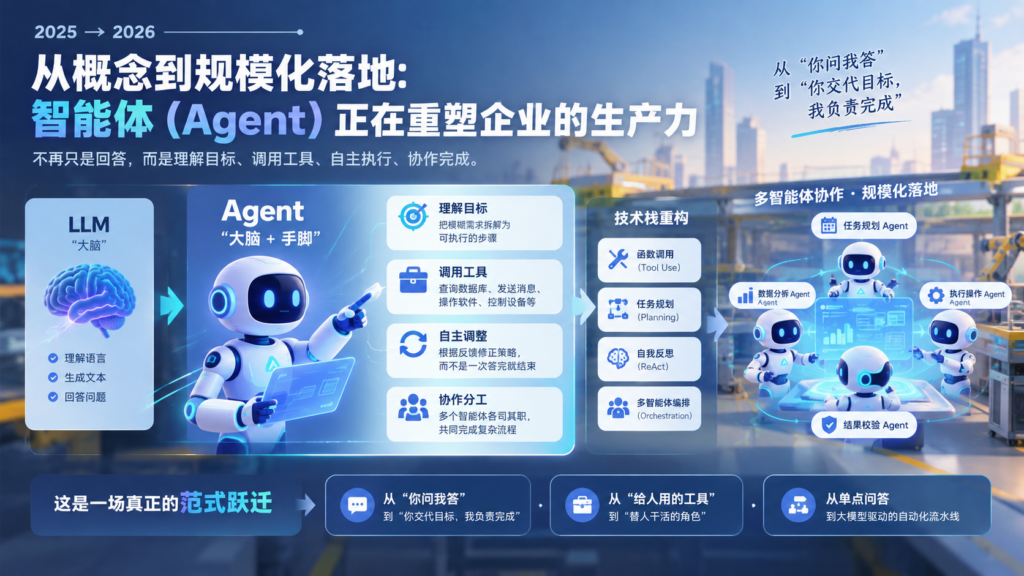
As the inaugural year of AI agents draws to a close, has your enterprise made its move?
I. Being Able to Chat Does Not Mean Being Able to Do From late 2022 to 2023, large language models (LLMs) gave machines the ability to “converse like a human” for the first time. You could discuss philosophy with them, ask them to write poetry, have them explain the theory of relativity… They could talk about virtually anything. But if you ask a business…
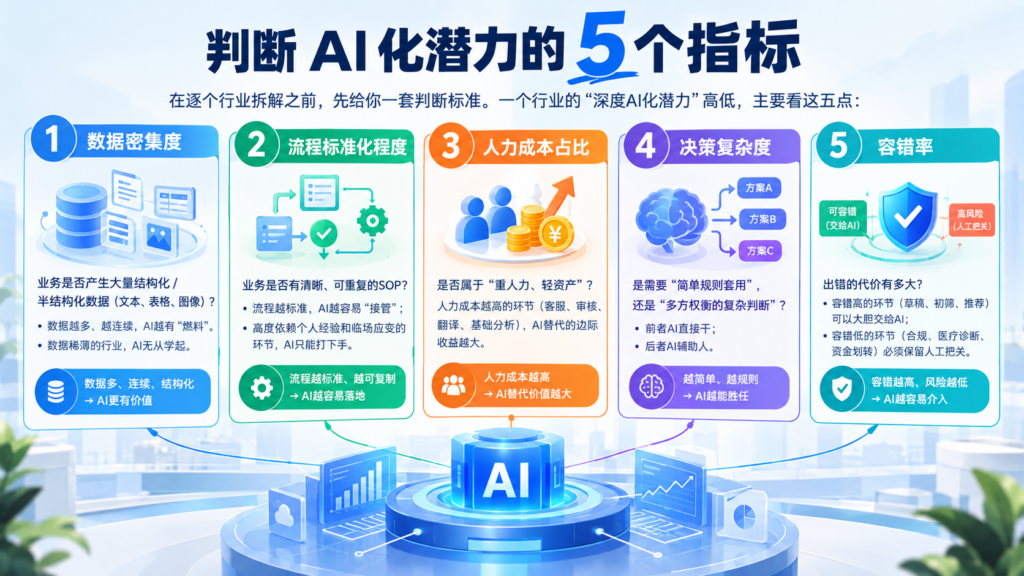
To determine whether an industry can be deeply AI-integrated, these 5 indicators are enough.
The previous article discussed “how enterprises can adapt to AI.” This one takes a different angle: which industries are inherently destined for deep AI-driven restructuring? This article presents a framework for assessing “AI potential” and breaks down real business scenarios and AI integration points across finance, healthcare, law, cross-border e-commerce, manufacturing, and more—helping you determine whether your industry is worth betting on. Introduction: The Gap…

How Business Owners Can Align Their Organizations with AI in the Age of AI
> **Abstract/Introduction**: AI is here, and what worries business leaders most is not “whether to use AI,” but “why have others cut costs and boosted efficiency with it, while my team just can’t get it off the ground?” This article provides a clear framework for enterprise AI implementation: from organizational pain points and selection methods to a 30-day launch checklist, and uses the Mofu Agent Platform as an example to explain exactly how these tools should be used. — ## I. First, the Truth: Where Most Enterprises Get Stuck Over the past year, I’ve seen many business owners repeatedly agonizing over the same question: **they’ve bought a pile of AI tools, their teams have started using them, but nothing seems to have changed in the business.**