
As the inaugural year of AI agents draws to a close, has your enterprise made its move?
I. Being Able to Chat Does Not Mean Being Able to Do
From late 2022 to 2023, large language models (LLMs) gave machines the ability to “converse like a human” for the first time. You could discuss philosophy with them, ask them to write poetry, have them explain the theory of relativity… They could talk about virtually anything.
But if you ask a business executive, “What has your company actually accomplished with AI?” many will fall silent.
Because chatting is a demonstration of technical capability; getting work done is what delivers value.
Large models have memorized vast amounts of knowledge and can express themselves fluently, but they have no hands, no processes, no permissions, and cannot be held accountable for results. They can answer “how to do this,” but they cannot actually “get it done.” This “last mile” is precisely the deepest chasm AI must cross in moving from technology into the real world.
Take the simplest example: you ask AI “why did workshop production capacity decline this month,” and it can give you a string of professional analysis covering capacity utilization rates, downtime hours, bottleneck workstations, and more. But if you ask it to “automatically reconcile this month’s planned versus actual output, identify workstations with excessive deviations, and push alerts,” it is at a loss—because the latter requires connecting to systems, pulling data, calculating metrics, making judgments, and then proactively reaching out to a specific person. One is “talk,” the other is “action”—a hair’s difference in appearance, a world of difference in value.
Language is the starting point of AI; action is the endpoint.
II. 2026: Agents Begin to “Truly Get Work Done”
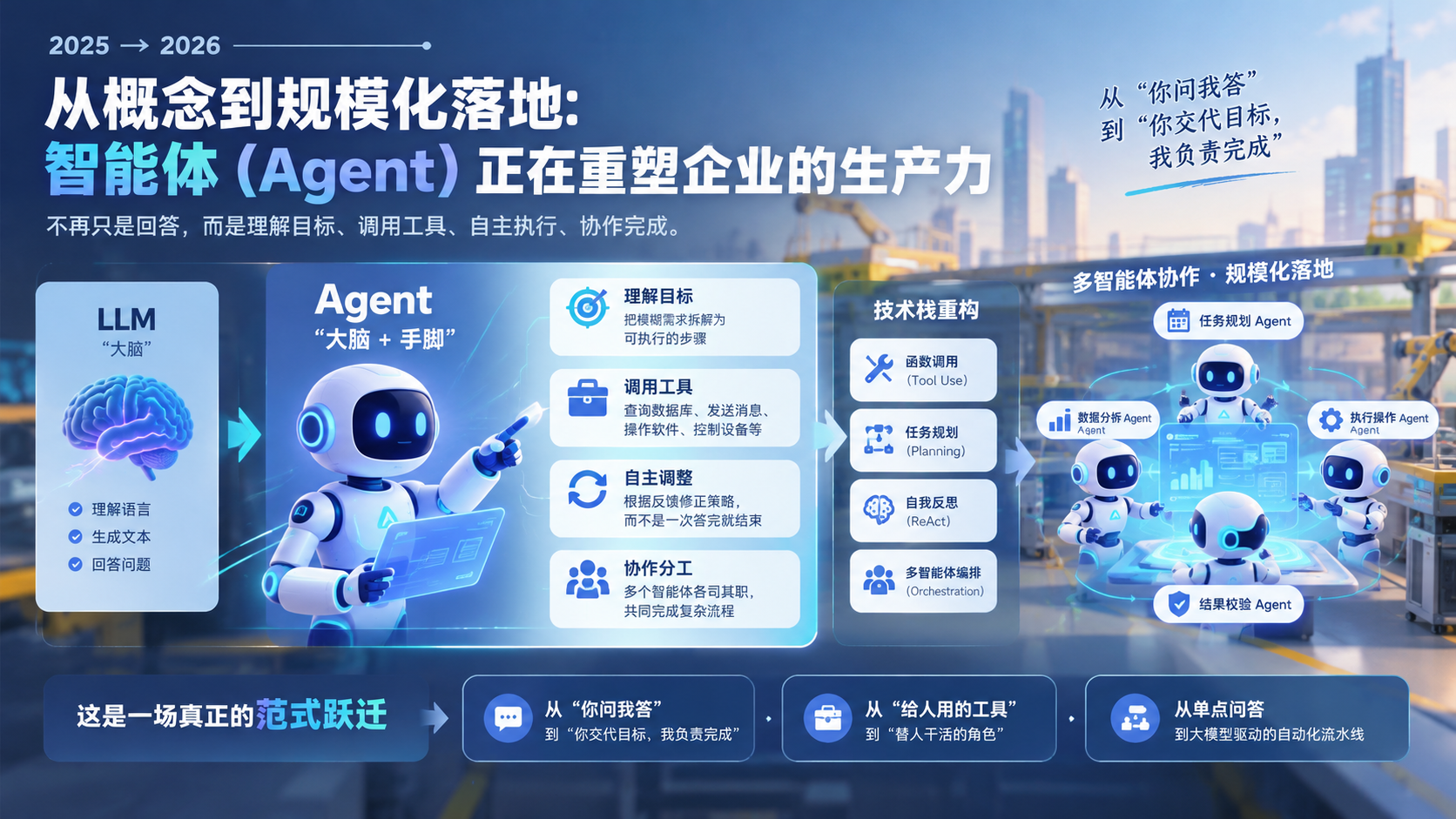
From 2025 to 2026, the most obvious signal in the industry is that agents are moving from concept to large-scale deployment.
If LLMs are the “brain,” then agents are the “brain + hands and feet.” They are no longer satisfied with answering—they can:
- Understand goals: break down a vague requirement into executable steps;
- Invoke tools: query databases, send messages, operate software, even control production line equipment;
- Self-adjust: revise strategies based on feedback during execution, rather than finishing after a single answer;
- Collaborate and divide work: multiple agents each performing their own roles, working together like a small team to complete complex processes.
Behind this shift is a restructuring of the technology stack: models have learned “function calling,” learned to break large tasks into small steps (planning), learned to self-reflect during execution and retry after failure, and learned to hand off their intermediate processes to other models for continued relay. Terms like ReAct, Tool Use, and multi-agent Orchestration are moving from papers into products, and then into real enterprise processes, at a visibly accelerating pace.
This is a true paradigm shift:
- From “you ask, I answer” to “you assign the goal, I take responsibility for completing it”;
- From “tools for people to use” to “roles that work on people’s behalf”;
- From single-point Q&A to large-model-driven automated pipelines.
For physical industries like manufacturing, this shift means: AI is no longer just a “document assistant” in the office, but potentially a “colleague” that can walk into the workshop and approach the production line.
III. Industry Deployment: When Agents Enter the Factory
Manufacturing is becoming one of the most imaginative testing grounds for AI agent deployment. The reason is simple: manufacturing has long processes, many stages, and large volumes of data, with repetitive labor and information gaps everywhere—and these are precisely the “pain point density” that agents are best at digesting.
Current real-world exploration is concentrated in several directions:
- Smart manufacturing: consolidate process parameters and quality inspection standards into knowledge bases, let agents assist with production scheduling and diagnose equipment anomalies, turning “decisions based on a veteran master’s experience” into “decisions based on data and rules”;
- Factory digitalization: connect ERP, MES, SCADA and other systems, turning “data islands” into “data rivers,” which agents then read, correlate, and schedule in real time;
- Process automation: hand off high-frequency cross-departmental, cross-system affairs such as inquiries, order placement, production scheduling, shipping, and reconciliation to agents, operating 24/7 to free employees from repetitive labor;
- Knowledge inheritance: the experience of veteran masters is no longer “inexplicable tacit knowledge,” but enterprise assets that can be structured, accumulated, and called upon by AI at any time.
I once saw a typical scene during research: a factory making precision components still relied on a master with twenty years of experience to “make scheduling decisions by gut feel,” and whenever he took a vacation, the entire workshop’s rhythm fell into disarray. Later, they loaded process parameters, equipment records, and historical scheduling data into a knowledge base, letting agents first “learn to match the master’s judgment,” then gradually take over routine scheduling—the master no longer had to stay up watching, and younger employees could also get up to speed. This is the most humble victory of agents in the real world: not replacing people, but turning “one person’s experience” into “a group’s capability.”
AI deployment in manufacturing is not about teaching machines to talk, but about teaching machines to work—and to understand whose factory they are in and whose rules they follow.
IV. The Future: From “Assistance” to “Agency,” from Tools to “Digital Employees”
Looking ahead, agents will continue to evolve along three lines:
- From assistance to agency: Today’s AI is “you ask, it answers; you click, it acts.” In the future, within clearly defined permission boundaries, it will make decisions autonomously, execute autonomously, and take responsibility for outcomes—evolving from “advisor” to “a person authorized to get things done.”
- From single point to coordination: A single agent solves a single problem, but only multiple agents working in concert can handle complex, cross-departmental, cross-system operations. Like a team—some take orders, some handle production scheduling, some handle reconciliation—each with their own role, yet interlocking with one another.
- From tool to digital employee: When an agent has an account, permissions, a knowledge base, and workflows, it is no longer “a tool” within the organization—it becomes a “digital employee” that can be evaluated, reviewed, and continuously optimized.
The impact on organizational form is profound: future management is not just about managing people, but also about managing “human-AI collaboration.” Production plans are no longer scheduled only for work crews—they must also be scheduled for “digital employees.” Performance evaluation covers not just headcount metrics, but also process efficiency and automation coverage. Managers must get used to a new daily routine: every morning, the system has already laid out the reports, exception lists, and recommended actions generated overnight on your desk—all you need to do is judge and decide—while the tedious collection, aggregation, and verification are being quietly taken over by agents.
Of course, there are boundaries on the road ahead that must be squarely faced: permissions must be clear, key decisions must retain human involvement, exceptions must have fallbacks, and data security and compliance must never be compromised. The more powerful the “agent,” the more it needs clear “reins.”
V. How Enterprises Should Prepare: Organization, Talent, Scenarios, and ROI
AI implementation has never been as simple as buying a system. For enterprises, the key question is not “whether to use it,” but “where to start.” Get four things straight, and you’re halfway there.
- Organization first: Form a small cross-departmental team (business + IT + AI), letting those who understand the business raise requirements and those who understand technology build the solution—avoiding both “tech for tech’s sake” and “the business can’t understand it.”
- Talent pipeline: Beyond algorithm engineers, place greater emphasis on FDEs (Forward Deployed Engineers)—professionals who don’t write complex models, but instead embed AI capabilities into an enterprise’s real workflows, solving the “last mile of deployment.” They are the scarcest people on the front lines of AI implementation.
- Scenario selection: Don’t aim too big. Start with scenarios that are “high-frequency, rule-clear, data-complete, and fault-tolerant”—prove one works, then replicate at scale.
- ROI-driven: Every pilot must have quantifiable metrics—how many person-hours saved, how much efficiency gained, how many errors reduced. Let data speak, then decide whether to scale.
The right approach to AI deployment is not to buy a large model first, but to think clearly first: which task is most painful, most easily quantified, and most worth automating.
VI. Truly Putting AI to Work: What the Mofu Agent Platform Can Do
Philosophy that doesn’t land on tools is just empty talk. This is exactly what the Mofu Agent Platform under Immersivalley is doing—it is an enterprise-grade agent platform whose core mission is to “help AI adapt and land,” turning all the methodology above into systems that actually run inside enterprises.
For enterprise managers, the value of the Mofu platform can be distilled into a few keywords:
- Multi-agent orchestration: Not deploying a single bot, but enabling multiple agents to collaborate along workflows—like a virtual team dividing labor and working together to handle complex, cross-departmental, cross-system operations;
- Capability assembly: Enterprises don’t need to build from scratch. The platform “assembles” large models, APIs, internal systems, and business processes together—like building blocks—to rapidly compose agents suited to the enterprise;
- Scheduled tasks: Many enterprise scenarios are “must-run-on-time”—such as daily operational reports, equipment inspection reminders, inventory alerts. Scheduled tasks make AI like a punctual machine, automatically getting to work on time;
- Knowledge base: Precipitation of process documents, quality inspection standards, and historical cases into an enterprise-exclusive knowledge base, so AI’s answers “understand this factory” rather than “speak in generalities.”
In other words: what Mofu aims to solve is precisely the last mile from “can chat” to “can work.” What it provides enterprises is not a chat window, but a deployment engine that can embed AI into real business processes and run according to enterprise rules.
Consider a specific morning: Sales places a new order in the system—the agent in Mofu immediately reads inventory and capacity, automatically determining delivery dates; the production scheduling agent arranges workstation plans by priority; the reconciliation agent automatically verifies documents after shipment; and the daily operational report is generated by a scheduled task at dawn, pushed to managers along with exception alerts. You haven’t even “operated” a single step, yet the entire chain has already started running automatically under your rules. This isn’t science fiction—it’s the everyday reality already achievable today by combining multi-agent orchestration, capability assembly, scheduled tasks, and knowledge bases.
For enterprises, the gap between philosophy and implementation is often just this one “assembly layer”: can AI be connected to existing systems, can it run according to business rules, and can people who don’t understand algorithms also use it. What Mofu does is make this “assembly layer” thinner—so that AI implementation no longer depends on a handful of technical experts, but returns to the business itself.
VII. Final Thoughts: AI’s Real Test Has Never Been “Can It Chat”
Looking back on this journey: large models taught us to “speak,” agents got us to “work,” manufacturing gave it the most solid testing ground, and platforms like Mofu filled in the “last mile.”
With every step technology takes forward, the road “from technology to the real world” gets a little shorter. What truly makes AI valuable has never been the number of parameters, but whether it has genuinely entered a production line, an office, and the day-to-day operations of an enterprise.
The ultimate test for AI has never been “can it chat,” but “can it get things done”—and, more importantly, is it willing to roll up its sleeves and do good work in your world?
What is the most painful task your company would want AI to tackle first? Share your thoughts in the comments.

Related articles
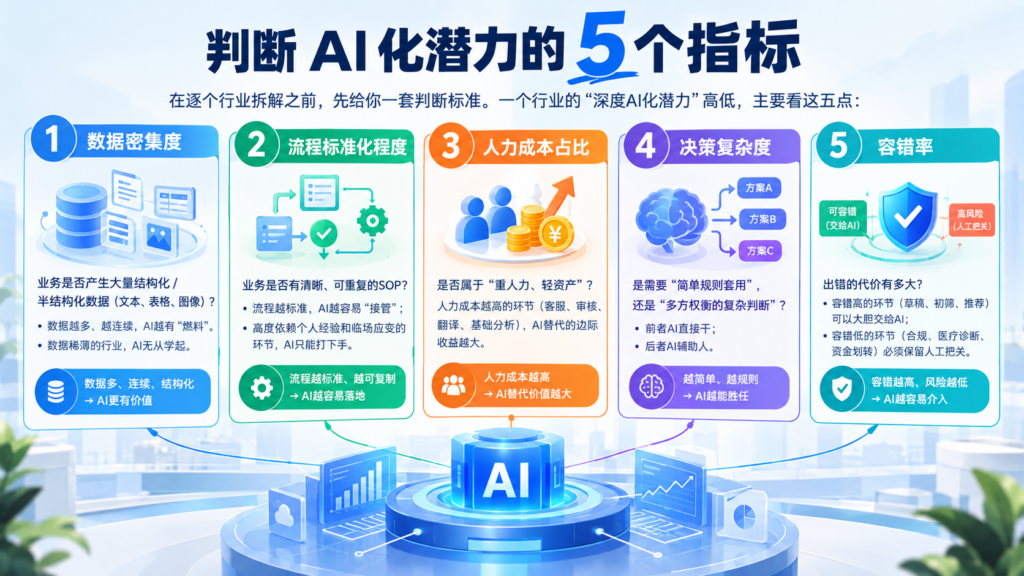
To determine whether an industry can be deeply AI-integrated, these 5 indicators are enough.
The previous article discussed “how enterprises can adapt to AI.” This one takes a different angle: which industries are inherently destined for deep AI-driven restructuring? This article presents a framework for assessing “AI potential” and breaks down real business scenarios and AI integration points across finance, healthcare, law, cross-border e-commerce, manufacturing, and more—helping you determine whether your industry is worth betting on. Introduction: The Gap…
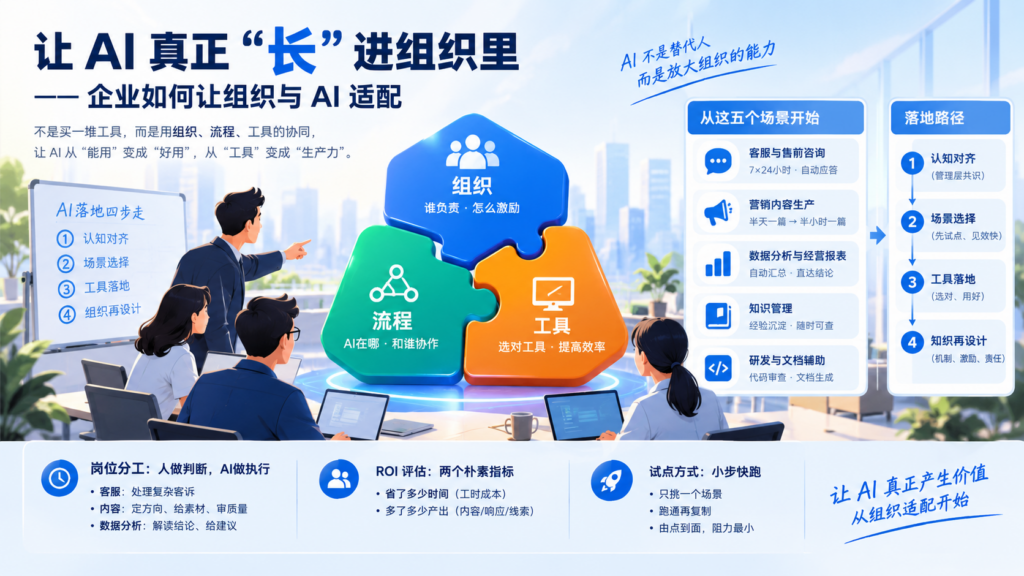
How Business Owners Can Align Their Organizations with AI in the Age of AI
> **Abstract/Introduction**: AI is here, and what worries business leaders most is not “whether to use AI,” but “why have others cut costs and boosted efficiency with it, while my team just can’t get it off the ground?” This article provides a clear framework for enterprise AI implementation: from organizational pain points and selection methods to a 30-day launch checklist, and uses the Mofu Agent Platform as an example to explain exactly how these tools should be used. — ## I. First, the Truth: Where Most Enterprises Get Stuck Over the past year, I’ve seen many business owners repeatedly agonizing over the same question: **they’ve bought a pile of AI tools, their teams have started using them, but nothing seems to have changed in the business.**
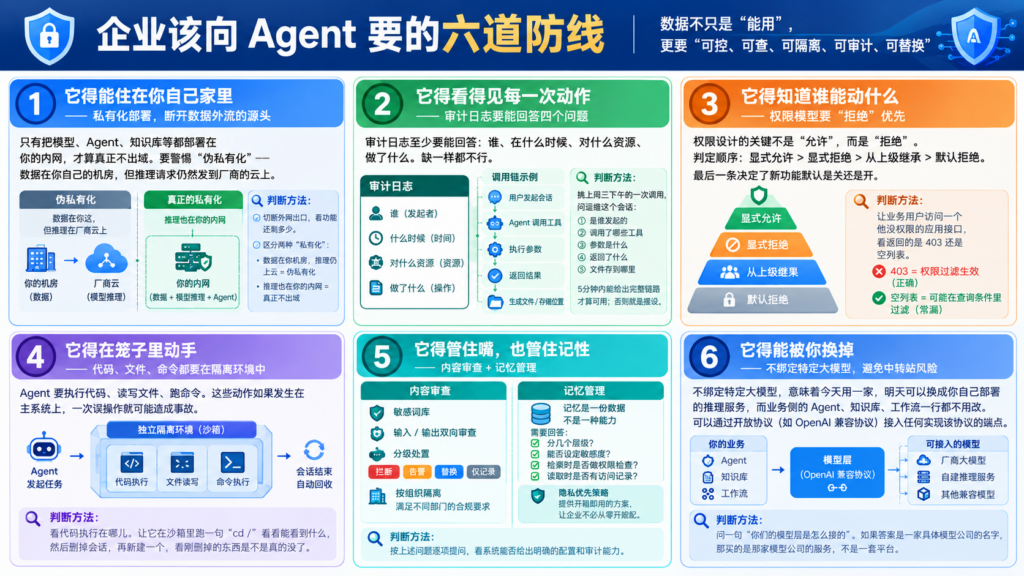
How Your Data Leaves the Company: The Six Lines of Defense Every Enterprise Agent Needs
When enterprises choose an AI Agent, the real question isn’t “will it secretly transmit data,” but “does it have the ability to transmit data, and can you see what it transmitted.” The former depends on the vendor’s integrity and can’t be written into acceptance criteria; the latter is a verifiable, auditable technical fact that can be written into a contract. Last month, during a…