
Should you grow your FDEs in-house or hire them from outside? Let’s talk straight.
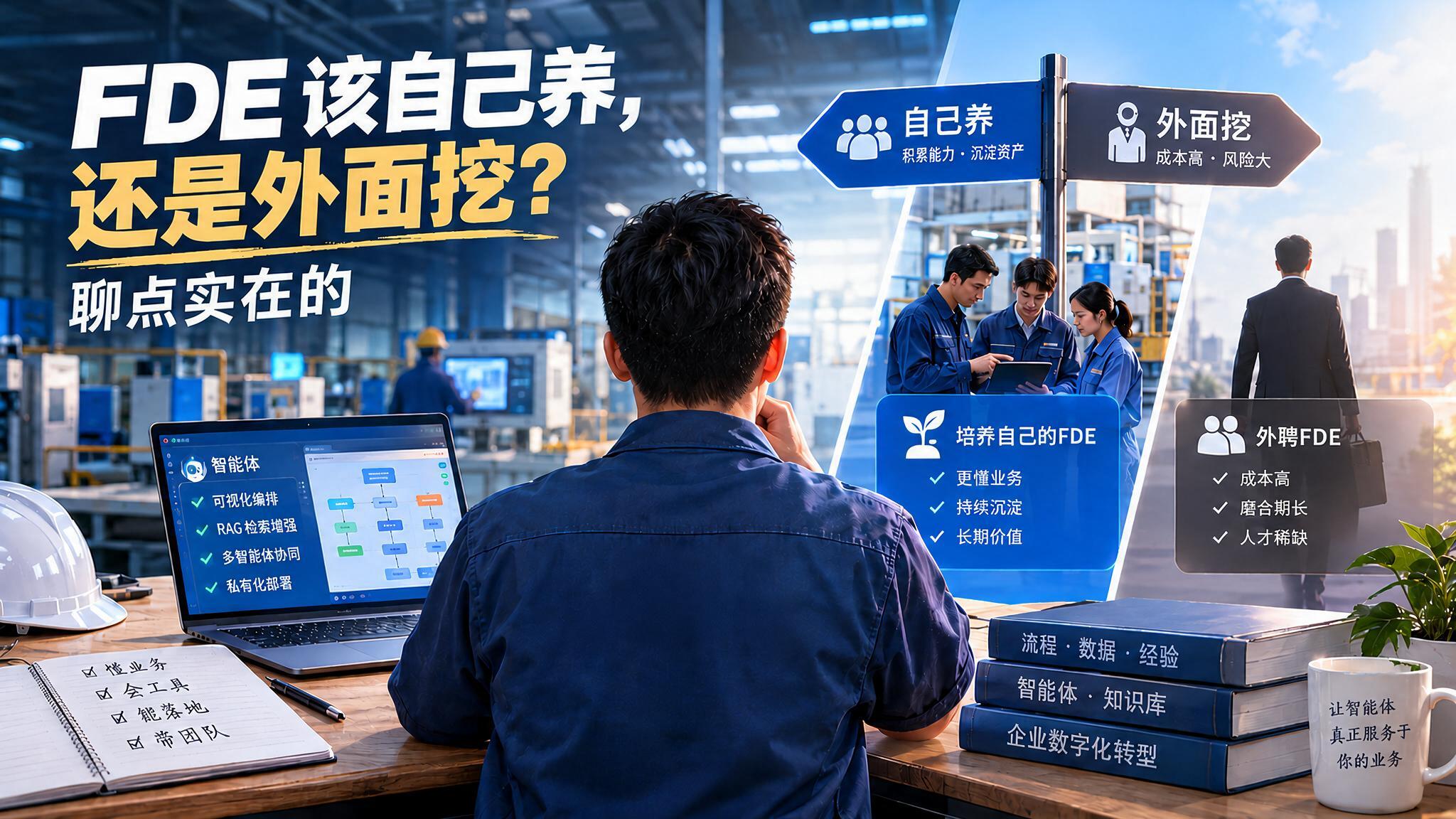
Last week I had dinner with a boss who runs an auto parts factory. He took a bite, looked at me, and asked: “Everyone’s talking about FDEs these days. Do I need to poach one from a big company? The ones I’ve talked to want 800K a year, and that’s before stock options.”
I said, hold off on opening your wallet. Let me ask you three questions first.
First, when your factory does production scheduling, that judgment call of “can this batch of orders be squeezed in?” — who can explain it in one sentence? Second, that twelve-year-old system in your warehouse — do you still have the API docs? Third, when the line stopped for two hours last week, what was the real reason, and is the version written in the report actually correct?
He froze for a while, then said: “All that stuff… it’s in people’s heads.”
I said, exactly. The person you’re looking for has to be someone who has “that stuff in their head.” The guy you poach from outside will definitely be better at tech than your veteran foremen, but he doesn’t have those three things in his head.
1If you can grow your own, don’t rush to poach
It’s not that hiring externally doesn’t work. It’s that I’ve seen too many factories spend the money, bring the person in, get the solution built — and then that AI agent sits on a server for a year and nobody ever opens it.
The problem isn’t technical. It’s that “he doesn’t know what he should be asking.”
Here’s an example that stuck with me. A factory paid big money to bring in an engineer with a solid algorithms background. He built a production scheduling optimization model — elegant logic, great-looking results. Three months after launch, usage was basically zero.
Why?
Because the most critical rule in scheduling is called “hidden mold-change loss” — how long it takes each machine to change molds, how far the first few dozen parts’ pass rate drops after a change. None of this exists as a field in the system. It only lives in the planning manager’s experience. The engineer asked plenty of questions, and he asked them diligently. But he didn’t know to ask about this one.
Is that his fault? No. Anyone coming in from outside would miss the same thing. Because he didn’t know it existed.
That’s the most expensive part of hiring an external FDE — not the salary, but the six months to a year of “catch-up learning.” And even after all that, he might not stick around.
2Hiring externally is renting capability; growing your own is building assets
Let me put this more bluntly.
External hire · Rented capability
The person stays, the capability stays. The person leaves, the capability leaves with them. What you’re paying isn’t a salary — it’s rent. And the rent goes up every year, because these people are genuinely scarce right now.
Grow your own · Accumulated assets
Every agent he builds, every knowledge base, every rule that gets codified — it all stays in your factory. The longer he works, the better he understands your business, and the more valuable he becomes. And that value lives in the organization, not on someone’s résumé.
Here’s a point that might matter even more: the barrier to entry for AI tools is dropping fast.
In the past, building any kind of automation meant writing code. Now on many platforms, you just describe the workflow in plain language, drag a few nodes, connect a few lines, and it runs. That means the scarcest FDE skill is no longer “can write code” — it’s “knowing what to let the machine do, and what not to.”
And that’s something only someone who’s been at the factory long enough can do best.
3Choosing the person: don’t pick the busiest, and don’t pick the most senior
This is the part I most want to hash out with you. Pick the wrong person, and everything after is wasted effort.
From what I’ve seen, the profile of someone worth developing looks roughly like this:
Five-plus years in the trenches.They know where the process gets stuck, which data is unreliable, and who’s quietly using Excel as a fallback. This kind of “dirty knowledge” isn’t in any document—and it’s the most valuable thing there is.
People with homegrown workarounds.Watch closely and you’ll notice some people build themselves little tools, write a couple of formulas, throw together a pivot table—anything to save themselves from daily repetitive work. It’s not laziness; it’s an instinctive intolerance of inefficiency—and that’s the core temperament of a good FDE.
Still curious, not afraid to tinker.Their first reaction to something new is “what could I use this for,” not “this thing is unreliable.”
Can translate between the shop floor and the meeting room.They can understand what the boss wants up top and talk shop with the veteran technicians down below. This ability matters far more than technical skill.
Willing to teach others.This one gets overlooked. Whether someone can do something and whether they can get others to do it are two different things. An FDE is supposed to develop a whole cohort of people—those who only care about being good themselves aren’t the right fit.
Now a few counterexamples—all pitfalls I’ve seen firsthand:
· Don’t pick the busiest star performer. They’re genuinely the most capable, but they have no time—give them the opportunity and they can’t take it on, and in the end nobody’s happy.
· Don’t pick the most senior “old hand.” They know the business inside out, but their first reaction to anything new is always “that won’t work.” It’s not a capability problem—it’s a mindset problem, and very hard to change.
· And don’t pick someone who just wants to “manage people.” An FDE is a hands-on role—you have to build things yourself. Pure coordinators don’t last.
So which positions should you recruit from? Production planning, process engineering, quality, equipment, IT—the core people in these areas are usually a good pool. On a side note, second-generation factory owners are actually an underrated group—they have both a business perspective and the authority to push things through, and they genuinely want to make the factory different. They’re often the first ones to break out.
4How to develop them: one scenario a week beats ten training courses
No grand theories here—just a few things I’ve found genuinely work.
Their first agent must be something they build for themselves.Don’t start with a “company-wide platform” or “factory-wide rollout.” Have them start with the thing that annoys them most every day—say, spending forty minutes every morning reconciling three spreadsheets. Once that’s done, they’re their own first user and their own first believer. No amount of persuasion from others works; saving those forty minutes yourself is what works.
Skip the training classes—learn by doing.A “study for two weeks, then start using it” format is basically wasted effort. A more reliable rhythm: pick one small scenario per week, do a retrospective every two weeks, and after each one spell out what worked well, what didn’t, and what to change next time. What you learn has to be used immediately, or you’ll forget it.
Practice “saying it clearly.”Most people get stuck not because they can’t click a mouse, but because they can’t articulate their requirements. Have them practice one exercise: turn a verbal request into four sentences—what result do I want, what materials do I have, what are the decision rules, and what happens when something goes wrong. Once those four sentences are clear, the agent can basically run correctly. And this skill benefits far more than just AI work.
Someone must have their back.The most common way this dies: a person starts enthusiastically, gets stuck at step two, asks around and gets no help, gets stuck again the second time—and there’s no third time. So either assign an external coach or designate an internal mentor, and make sure that when they’re stuck, someone can lend a hand within two hours.
What they build must go into the cabinet.Agents, knowledge bases, prompts, templates—all of it needs to be archived, reusable, and editable by the next person. Skip this, and ten builds are ten isolated islands—the moment the person leaves, it all falls apart. On this point, choosing the right tool makes a huge difference.
Give them time, and give them recognition.Set aside a fixed half-day each week—don’t make people do this on their own time after hours, or they won’t last a month. Those who produce results should present them at meetings and let the whole factory know. Many factories can’t get this off the ground not for lack of talent, but because nobody wants to be the person who “does extra work and gets no credit.”
5What role does AgentSteamer play in all this
The starting point behind AgentSteamer is really just one sentence: let a company’s own people build and nurture agents themselves.
It’s built around the Harness Engineering methodology of engineered governance, covering the full lifecycle of an agent—from creation, visual orchestration, testing, and publishing to operational governance. It’s not a tool we hand you and walk away from; it’s about enabling standardized production and continuous operation.
In terms of concrete capabilities, several are directly relevant to “developing your own FDEs”:
Visual orchestration.Business people can string processes together without writing code.
RAG retrieval augmentation.It can ingest your factory’s SOPs, drawing notes, maintenance records, and historical work orders, so the agent speaks your factory’s language.
Multi-agent collaboration.A primary agent dispatches to several specialized sub-agents based on intent, breaking big problems into small ones—so one person can handle it all.
Add model management, a skills and tools system, and context engineering on top of that. Make what you build maintainable, not disposable.
On deployment, it’s fully private—the knowledge base and artifacts stay within the enterprise’s own domain, and data never leaves the premises. This looks like a technical detail, but it’s actually crucial: only when data never leaves the factory will veteran workers dare to put the real stuff in.
In terms of scenarios, the ones we run most often are intelligent office work (documents, PPT), intelligent operations (process automation), intelligent customer service (knowledge Q&A), intelligent review (rule-based judgment plus AI review), intelligent research (multi-source retrieval and analysis), and intelligent O&M (monitoring plus automated handling). We’ve also left flexibility in billing—License subscription or a one-time package, choose at your own pace.
As for our role, I’d rather call it a sparring partner than a stand-in. We hand you the platform and the methodology, you pick the people from your own team, and together we get the first batch of scenarios running. Once they’re running, you can push forward on your own.
6Hiring externally isn’t wrong—it’s about putting them in the right place
Having said so much about the benefits of developing people in-house, I should be fair: hiring externally isn’t wrong in itself—the mistake is treating it as your main force.
If you must hire externally, the advice is few and excellent—one or two, positioned as seeds, as coaches. Their job isn’t to do all the work, but to bring out five of your own people. After a year, their value becomes “yours.”
Conversely, if you expect external hires to carry the load—then when the day comes that they leave, you’ll find the agent is still on the server, but no one knows why it was designed that way. That’s more trouble than not having it at all.
FDE isn’t really a new position—it’s more like a capability: thinking the business through clearly, then telling the machine what to do.
This capability can’t be parachuted in; it can only grow. It grows in the noise of the workshop, in the arguments of the planning department, in all those sayings of “this is how we’ve always done it.”
Rather than spend 800,000 to poach one person,
spend half a year cultivating three from your own team.
Those three are the real foundation of your factory’s future.

Related articles

I spent twenty years doing on-site ERP work, and now I’m packing my bags again to go be an FDE.
Twenty years ago, I was a young guy doing ERP implementations. The project was at the client’s factory, and I’d drop my suitcase in the dormitory and consider myself moved in. Days I’d be buried in procurement, the warehouse, finance; nights I’d be back in the office tweaking configurations until the small hours. One stay would last half a year. What I did back…
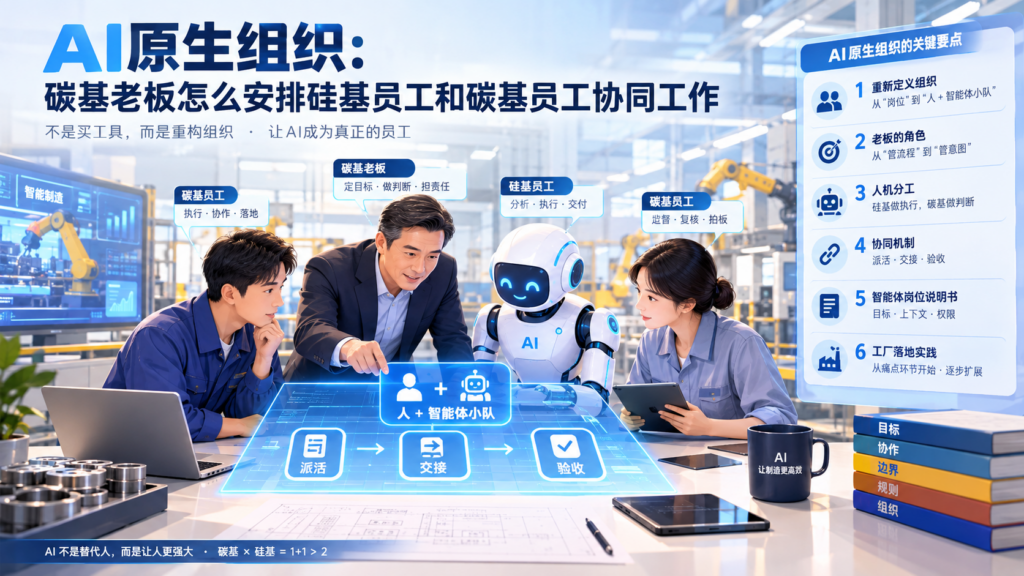
AI-Native Organizations: How Carbon-Based Bosses Arrange Collaboration Between Silicon-Based and Carbon-Based Employees
Over the past couple of years, I’ve chatted with quite a few bosses in manufacturing and factory operations, and the conversation always circles back to the same question: how exactly do you put AI to work inside a company? Most people’s first instinct is still “buy a tool.” Get an AI customer service bot, spin up a large language model, have IT hook up…
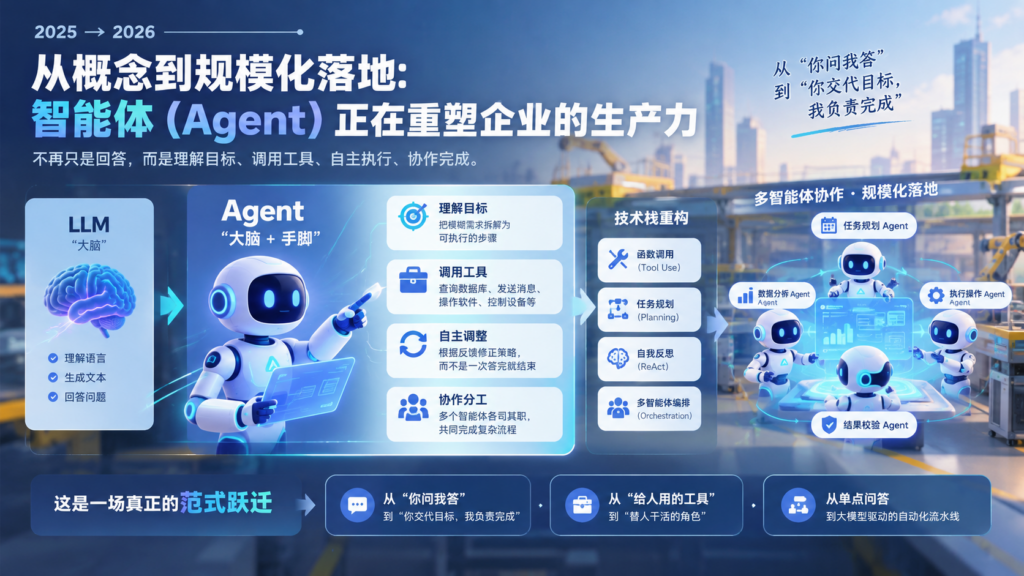
As the inaugural year of AI agents draws to a close, has your enterprise made its move?
I. Being Able to Chat Does Not Mean Being Able to Do From late 2022 to 2023, large language models (LLMs) gave machines the ability to “converse like a human” for the first time. You could discuss philosophy with them, ask them to write poetry, have them explain the theory of relativity… They could talk about virtually anything. But if you ask a business…