
Multi-agent systems are not just chaining several agents together.
A G E N T S T E A M E R · A I O B S E R V E R
2026-10-26 | 2,155 words | ~5 min read | Multi-agent orchestration
N E W S S U M M A R Y
Zhizi Agent 1.0 isolates the pipeline stages of “role expression, knowledge retrieval, and content validation” within its runtime, forming a closed loop of “generation—discrimination—targeted correction” through multi-agent collaboration; its in-house inference architecture reduces first-token latency by 51.5%.
What’s really worth copying from this release isn’t that latency number—it’s the decision to separate generation from validation.
Source: Science and Technology Daily / China Science and Technology Network, “Infinigence AI and Three-Body Universe Jointly Release Zhizi Agent 1.0,” 2026-10-26
https:/
This “generation—discrimination—targeted correction” sounds like jargon, but it’s actually the part of multi-agent design that gets skipped most often. Most teams only build the first stage.
A typical demo goes like this: one agent understands the requirements and breaks the task into several parts; a second retrieves materials; a third writes; a fourth revises.
It runs smoothly during the demo because the requirements are prepared in advance, the materials are findable, and someone is watching the output and revising it.
Put it into real business and it falls apart. The same task gets split into four steps the first time and seven steps the fifth time; the materials retrieved in the second stage don’t match the assumptions from the first stage; halfway through writing, you discover the premise was wrong, and no one decides whether to roll back.
These failures are rarely logged as “multi-agent faults.” They usually get filed under “unstable performance,” and then the team goes back to tweaking prompts.
There’s an even more insidious version: the several agents chained together are actually the same agent with four different sets of prompts. It looks like a division of labor, but the context is shared, the knowledge is the same, and the permissions are the same. This structure shows no difference in a demo, but the moment you scale up, it’s exposed—because real division of labor means different capability boundaries, and swapping prompts can’t create capability boundaries.
▍Chaining processes vs. chaining judgments
| Chaining Flows | Chaining Judgments | |
| What is being chained | A finishes and hands off to B | Which path to take this time, and whether it’s right |
| Who makes the judgment | Still the same agent | An independent evaluation step |
| Failure symptoms | No idea which step went wrong | Can pinpoint the step and version |
| At scale | Inconsistent results | Errors are affordable and fixable |
Connect several agents end to end, and what gets chained is the flow. A flow is deterministic: A finishes and hands off to B, B finishes and hands off to C.
But in real business, the hardest part isn’t the flow—it’s the judgment. Which path to take this time, whether what was retrieved is sufficient, whether what was written is correct, and where to roll back to after an error—these are all judgments.
Who you hand those judgments to determines whether the system is usable.
Hand them to the same agent, and it ends up grading its own work. This is very common in practice: the generation step and the verification step use the same prompt, and the check result is “looks fine.”
Hand them to rules outside the flow, and you can only cover the parts with clear-cut criteria. Amount over limit, required field empty—those can be caught. “This phrasing doesn’t match the company’s official position”—that can’t.
The rest has to be handled by another role. That’s why a multi-agent system needs a dedicated evaluation role.
That’s exactly what the pipeline isolation in the Zhizi Agent is about.
During generation, the character’s goal is “to get something written.” During discrimination, the goal flips: find problems. These two goals fight each other within the same context—one pushes forward, the other picks apart—and mixing them together turns into self-confirmation.
Once separated, the discrimination stage can have its own knowledge, its own standards, and its own output format. It doesn’t need to know which prompting tricks were used during generation; it only needs to know what counts as unacceptable output.
The correction stage is different again. It’s targeted: if discrimination flags a specific item as wrong, it fixes that item—not rewrite the whole thing. Rewriting damages parts that were already correct and doubles the cost.
The permissions for these three stages should also be separated. Generation can read and write; discrimination can only read; correction can write, but its output must pass through discrimination again. This design sounds cumbersome, but it turns “nobody knows where it went wrong after a task run” into “every stage has its own responsibility boundary.”
Rollback also needs to be decided in advance. When discrimination says no, do you redo the entire task or just fix that one segment? Redoing the whole task is expensive, but fixing one segment easily creates inconsistencies. The more robust approach is to split the task into bounded units, discriminate and retry each unit independently, and leave cross-unit consistency to a final check layer. This design must be settled when you build the orchestration—it can’t be patched in afterward.
In multi-agent systems, there’s one role that’s easy to design wrong: the main agent.
The common mistake is making it do everything: understand requirements, break down tasks, call sub-agents, aggregate results, and then write a version itself at the end.
It should really only do two things: decide who to call this time, and collect the results. Deciding who to call is routing; collecting results is aggregation. Everything in between goes to specialized agents.
Why design it this way? Because routing relies on a capability catalog, not on knowledge. The main agent needs to know which agents exist, what each is good at, and whether they’re currently available—this is structural information. Making it understand business details actually slows it down.
Routing has another benefit: failures are locatable. If a task goes in the wrong direction, you can tell whether a routing step made the wrong call or a sub-agent itself erred. These two types of problems require completely different fixes—the former means changing intent recognition, the latter means changing specialized capabilities. Cram everything into one big agent, and all you see is a wrong final result; the rest is guesswork.
On permissions, the main agent should ideally have no direct access to business systems. It only calls sub-agents and doesn’t touch data. Once this rule is broken, a misdirected main agent can bypass all sub-agent boundaries.
Claude Duet is said to be able to call over six thousand connectors on the Marketplace, and it comes with an independent virtual machine and browser environment—it can keep running in the background even after the device is turned off.
For consumers, many tools mean capability; for enterprises, they mean risk surface. Six thousand entry points—each one could be a leak for data exfiltration, or a dangerous action that can be invoked incorrectly.
The enterprise approach is usually the reverse: tighten the funnel first, then open up.
There are several ways to tighten the funnel. Authorize by agent: this agent can only use these three tools, and nothing else is reachable. Authorize by scenario: the inbound/outbound scenario can only query inventory tables, not touch orders. Constrain by parameter: the same interface allows queries but not modifications; allows modifications but not batch modifications.
Jensen Huang put those three elements together—orchestration framework, isolated sandbox, callable tools—and the order looks right now. Orchestration enables division of labor; a sandbox makes it safe to grant tools; tools make real work possible. Miss any one of the three, and multi-agent is just a demo.
In practice, a team typically spends the first two months just clarifying “who calls whom.” This period produces no visible functionality, making it hard to justify in review meetings. But projects that skip this step will later spend the same two months trying to investigate something that can’t be investigated at all.
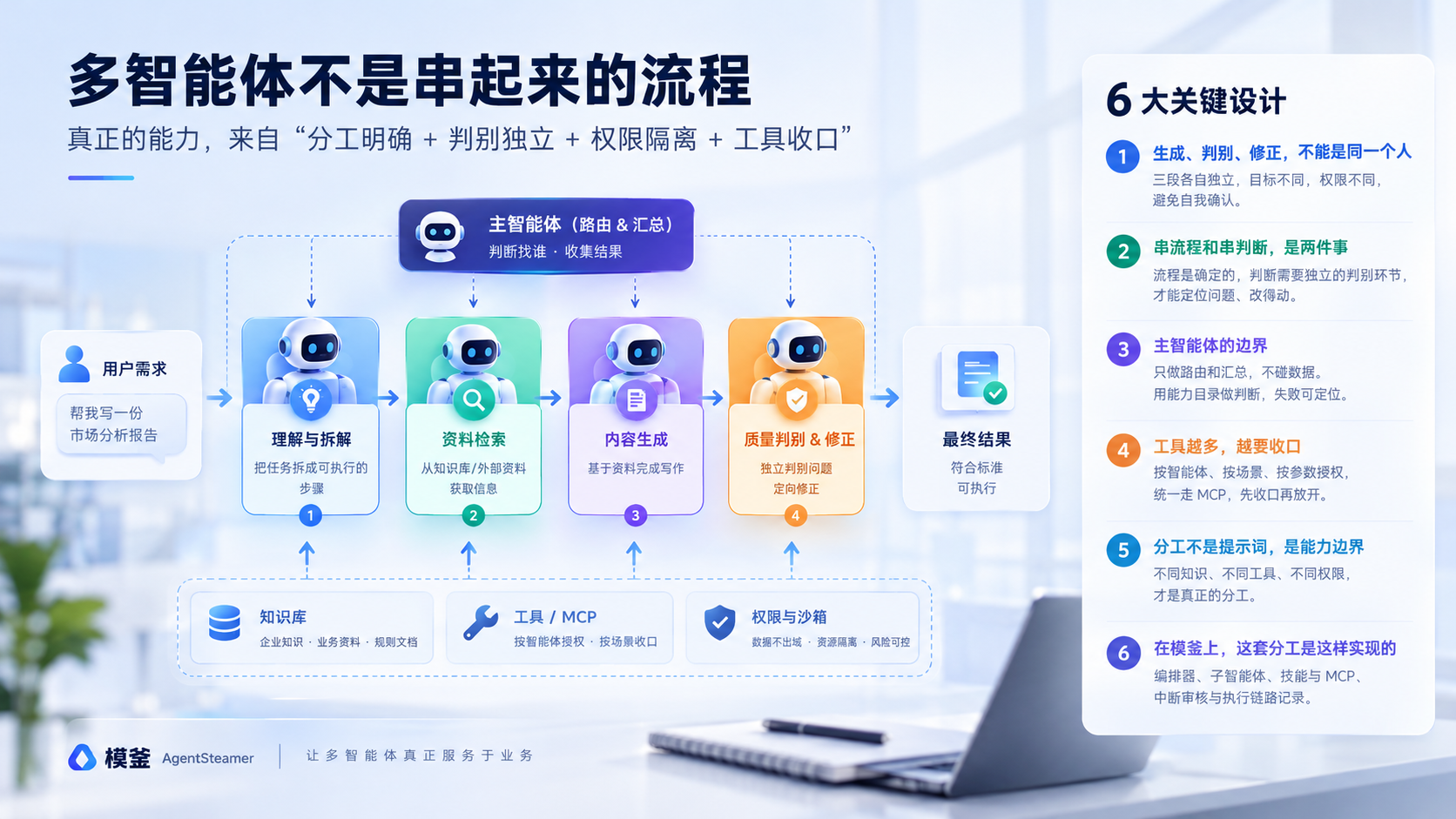
In AgentSteamer, roles are separated through configuration, not prompts:
The orchestrator fixes the problem of “the main agent doing everything.”
The main agent does only two things: determine by intent who should handle the task, and collect the results. The work in between goes to specialized sub-agents; it never touches the data itself.
Each sub-agent’s dedicated knowledge base and tool permissions fix the problem of “faking division of labor with four paragraphs of prompts.”
Different knowledge, different permissions, different callable tools—that is what makes capability boundaries real, not just different wording.
Centralizing skills and MCP fixes the problem of “the more tools, the greater the risk.”
Tools are assigned per agent, permissions per resource, and all external systems are integrated uniformly through MCP rather than connected piecemeal.
Interrupt-and-review plus execution trace logging fix the problem of “when a task goes off track, you can’t tell which step went wrong.”
Stop at forks in the road and wait for a human; keep a trace of the full run. This separates routing errors from capability errors—two kinds of problems, two kinds of fixes.
AgentSteamer
An enterprise-grade agent platform by Immersivalley (Shanghai), deployed privately, managing agents, skills, workflows, prompts, memory, and artifacts as assets.
The external facts cited in this article were retrieved on 2026-10-26 from public media reports; the media outlet and date are noted in the text. Figures concerning third-party companies reflect the original reports and do not represent this platform’s customers. We recommend verifying against the primary sources before publication.
SOURCES
“Infinigence AI and Three-Body Universe Jointly Release Zhizi Agent 1.0,” Science and Technology Daily / China Science and Technology Network, 2026-10-26, https:/
“Anthropic Launches Claude Duet AI Agent,” Huanqiu.com / NetEase, 2026-10-22, https:/
” The Era of AI Agents Has Arrived! Meta Cracks the Consumer Market, NVIDIA Bets on Infrastructure, and Marketingforce Sets a Local Benchmark for Agent Deployment,” China Daily, 2026-10-23, https:/

Related articles

Private deployment isn’t about buying a server—it’s about buying an engineering capability that keeps data within your domain.
The challenge of private deployment isn’t whether the machines have been moved into your data center—it’s whether knowledge, conversations, artifacts, and logs have any path that leads out. Below is a checklist you can take to align with your vendor.

Should you deploy the agent platform in your own data center, or use someone else’s first?
Private platforms and public platforms aren’t about which is stronger—it’s about whether you’re missing the car or the garage. Three questions are basically enough to decide.

Should you grow your FDEs in-house or hire them from outside? Let’s talk straight.
Last week I had dinner with a business owner in the auto parts industry. He took a bite of food and asked me: “Everyone’s talking about FDEs these days. Do I need to go poach one from a big company? They’re asking for 800,000 a year, and that’s before stock options.”
I said, don’t rush to open your wallet just yet. Let me ask you three questions. First, when your factory is scheduling production, who can explain in one sentence how the decision is made on whether “this batch of orders can be squeezed in”? Second, that old system in your warehouse that’s been running for twelve years—do you still have the API documentation? Third, when the production line shut down for two hours last week, what was the real reason, and is the version written in the report actually correct?
He was stunned for a long moment, then said: “These… they’re all