
Private deployment isn’t about buying a server—it’s about buying an engineering capability that keeps data within your domain.
AgentSteamer · AI INSIGHTS
2026-10-26 | 2,195 words | Approx. 5 min read | Private deployment
IN THIS ISSUE
The article addresses the practical challenge facing mid-to-large enterprises: keeping data off the public internet. According to the piece, one technology company reported that after adopting a research and development collaboration agent, its R&D team's manpower input for routine feature iteration scenarios was optimized by nearly 40%.
Another set of reference figures comes from an Accenture China survey reported by China Daily on October 21: 63% of Chinese enterprises have deployed AI assistants or AI-enabled knowledge management systems, up from just 28% a year earlier.
Source: China Economic Net, "Private Enterprise AI Agent Platforms: How to Solve the Core Challenge of Keeping Data Off the Public Internet for Mid-to-Large Enterprises," 2026-10-24
https:/
The China Economic Net piece on private deployment platforms asks in its title: "How to Solve the Core Challenge of Keeping Data Off the Public Internet for Mid-to-Large Enterprises." It's a very grounded question: the hard part isn't moving machines into the data center—it's that after they're in, the data is still leaking out.
I once saw a company go through private deployment acceptance. The hardware checklist, network topology, and cybersecurity compliance materials were all meticulously prepared. Then someone at the review meeting asked: Where is the knowledge base stored? How long are conversation records retained? The room went silent for a few seconds.
The most common approach to private deployment is to treat it as a procurement project. How many servers, what GPU model, how much bandwidth, which floor the data center is on—these are all easy to list.
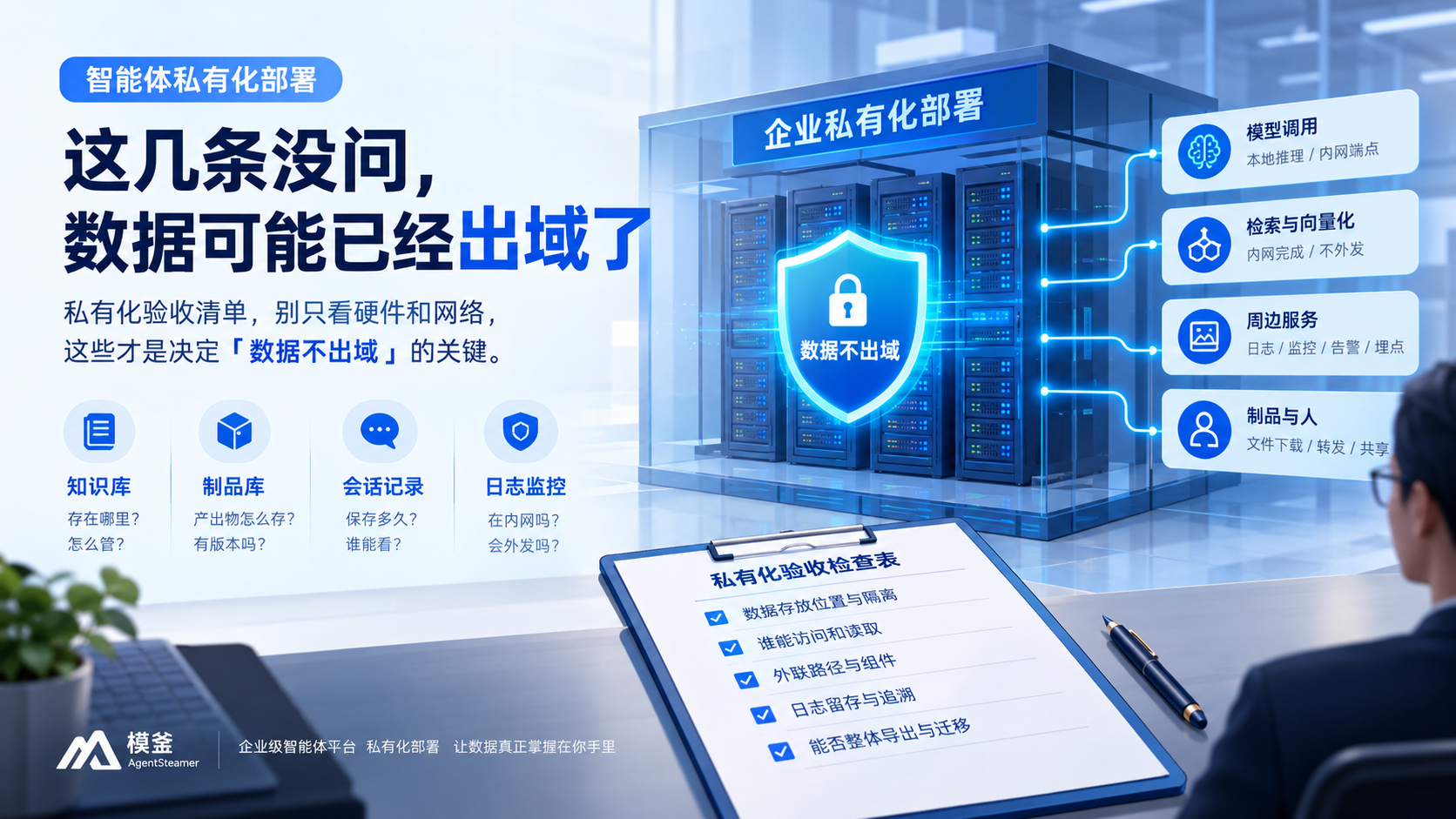
What actually determines whether "data stays in-domain" are a few other lines—after knowledge documents are parsed, which directory do they land in? Where are artifact files (documents, reports, and code produced by the agent) stored? Do user-agent conversation records go into a third-party logging service? Are model calls handled by local inference or routed through an external API?
If these lines aren't written down, acceptance can still pass. That's exactly what happened in one project: all hardware was in place, the monitoring dashboards looked beautiful—and then it turned out all conversations were being sent to a cloud logging service. The justification was perfectly reasonable: it makes troubleshooting easier.
Troubleshooting is indeed a genuine need. So the right move isn't to turn off logging—it's to bring the logging service itself in-house. Architecturally, this isn't difficult. What's difficult is someone remembering to ask.
▍Hardware in the Data Center ≠ Data Stays In-Domain
| Hardware privatization | Data stays in-domain | |
| What it covers | Servers, storage, network | The full chain: knowledge, sessions, artifacts, logs |
| Model calls | Not necessarily—may still go through external APIs | Local inference, or explicit routing rules |
| Vectorization | Frequently overlooked | Done on the internal network, never sent out |
| Logging and monitoring | Points to vendor services by default | The services themselves are deployed on-site |
Count the outbound paths, and there are usually four.
The first is model calls. When you use an external API for inference, whatever you ask naturally goes out. This one is the most obvious and the easiest to think of.
The second is retrieval and vectorization. Chunking text and computing embeddings—if this step calls an external service, then every passage in your knowledge base has gone out at least once. This one is the most hidden: many people assume that “vectors stored locally” means it’s safe, but the process of generating those vectors happens outside.
The third is peripheral services. Logs, monitoring, alerting, crash reporting, analytics—the default configurations of these auxiliary components mostly point to vendor servers. They don’t handle business data directly, yet they often carry context out along the way.
The fourth is artifacts and people. Someone downloads a file generated by the agent to their phone and forwards it to WeChat. The system doesn’t govern this path, but the requirements document needs to spell out where the boundary lies.
Three of the four are technical configuration issues, and they can be fixed. Only after that can you talk about “data stays in-domain.”
Of the four, the third is the one most easily dismissed as irrelevant. It isn’t a business feature, and no one demonstrates “we turned off logging” during acceptance. A friend who does implementation work said he’s visited more than a dozen clients claiming to have done privatization, and fewer than half could clearly state that monitoring and logging were on the internal network. The rest all said, “It should be in there, right?”
That “should” is exactly where the risk lies. It’s not a matter of technical difficulty—it’s that no one put this item on the acceptance checklist.
These three types of data have different characteristics, so they should be stored differently.
The knowledge base is an enterprise’s most critical static asset. It needs version control, traceability, and department-level isolation. It should not be a shared read-write directory—that’s like putting the original text of your policies on a public drive.
Artifacts are dynamically produced outputs. Reports generated from a task, modified spreadsheets, written scripts—if no one manages them, six months later they’ll be scattered across personal files, email attachments, and temp directories. They need to go into an artifact repository with versioning, ownership, and review status.
Session records are the most easily dismissed as debug junk. In reality, they are both audit evidence and a source of memory. How long to retain them, who can view them, and to what degree they should be desensitized—these three things are best decided at project kickoff, before legal comes asking.
In that Securities Times report, the major tech company explicitly supported public cloud, dedicated VPC, on-premises, and hybrid cloud deployment models. This list of options has become standard in the industry.
Choosing which one isn’t a matter of ideology—it’s a matter of accounting. Fully private is the most expensive: you maintain the hardware yourself and track model upgrades yourself. Hybrid is the most flexible, but architectural complexity goes up and boundaries get blurry. Dedicated VPC is the compromise: decent isolation with less operational burden.
Here’s a useful criterion: which data, if leaked, would immediately put the company in crisis? Make the processing pipeline for that data fully private, and choose the rest based on cost. The vast majority of enterprises end up with this combination—no need for a one-size-fits-all approach across the entire system.
For hybrid architecture boundaries, I recommend drawing them along “data classification” rather than “system modules.” If you draw them by module, you’ll often find a single module containing both sensitive and public fields, and to keep things running you’ll just let the whole thing through. Draw them by data classification instead: ordinary fields go to external inference, sensitive fields go to local models. It’s more troublesome, but the boundaries are clear.
China Daily reported that, according to an Accenture China survey, 63% of Chinese enterprises have deployed AI assistants or AI-enabled knowledge management systems, up from just 28% a year earlier. More than doubling in a year means many deployment decisions were rushed without clear boundaries—and there will likely be catching up to do later.
Finally, here are a few questions you can ask directly.
Where is the data stored: Where exactly do the original knowledge text, vectors, artifacts, and sessions reside—are they all on the internal network?
Who can read it: Can departments search each other’s knowledge? Can administrators view session records in plaintext?
What goes out to the internet: Besides model inference, which other components make outbound connections, and can they be disabled?
What can be traced when something goes wrong: How far back can a complete task pipeline be traced, and how long are logs retained?
Can you migrate if you switch vendors: Can knowledge, artifacts, and prompts be exported in bulk, and are they still usable after export?
That last one is the most easily overlooked in on-premises projects—and the most critical. The data is in your data center, but the format and metadata belong to someone else. You’re still locked in.
Vendor lock-in manifests in very concrete ways: the knowledge base structure is proprietary, so exporting gives you just a pile of text with no hierarchy; prompts and workflows live in the vendor’s repository; artifact version history is tied to a particular account system. When it really comes time to switch, what you can take away is the raw files—what you can’t take away is the half-year’s worth of organized interpretation. That’s the part that’s actually valuable.
So when discussing private deployment, besides asking “Is the data on my premises?”, you should also ask “Can I take it with me?” The first question secures safety; the second secures control. You need to be able to answer both for the private deployment to be the right purchase.
AgentSteamer was built with private deployment as its foundational form from the very beginning. These points aren’t promises—they’re product capabilities you can verify.
Private deployment ensures “the inference call never leaves the network.”
Mount local or intranet-compatible endpoints in model management. To switch models, just change the configuration—no need to touch the workflow.
The artifact repository ensures “outputs don’t scatter across individual computers.”
Reports, spreadsheets, and scripts generated by agents go into the repository—with versions, ownership, and review status—instead of floating around in email attachments.
Audit and session trails ensure “logs and monitoring don’t inadvertently carry context outside.”
These components are installed inside the intranet along with the platform, so troubleshooting doesn’t require an external connection.
Access control ensures “once things are inside the intranet, not everyone can browse them.”
Resources are authorized separately by application, knowledge base, file, log, and session; operations are further divided into read, modify, delete, and execute; department-level inheritance is supported, and access is off by default.
AgentSteamer
An enterprise-grade agent platform by Shanghai Immersivalley, privately deployed, managing agents, skills, workflows, prompts, memory, and artifacts as assets.
External facts cited in this article were retrieved on 2026-10-26 from public media reports; the media name and date are noted in the text. Figures concerning third-party enterprises reflect the original reporting and do not represent this platform’s customers. It is recommended to verify against primary sources before publication.
FACT SOURCES
“Private Enterprise AI Agent Platforms: How to Solve the Core Challenge of Keeping Data Within the Intranet for Mid-to-Large Enterprises,” China Economic News Service, 2026-10-24, https:/
“ManageEngine Releases 30+ AI Agents with Zero Token Usage Cost,” China Daily Network, 2026-10-21, https:/
“Another Internet Giant Targets the Enterprise Market: Baidu’s Dazi Brings AI Applications to the Production Line,” Securities Times Network, 2026-10-22, https:/

Related articles
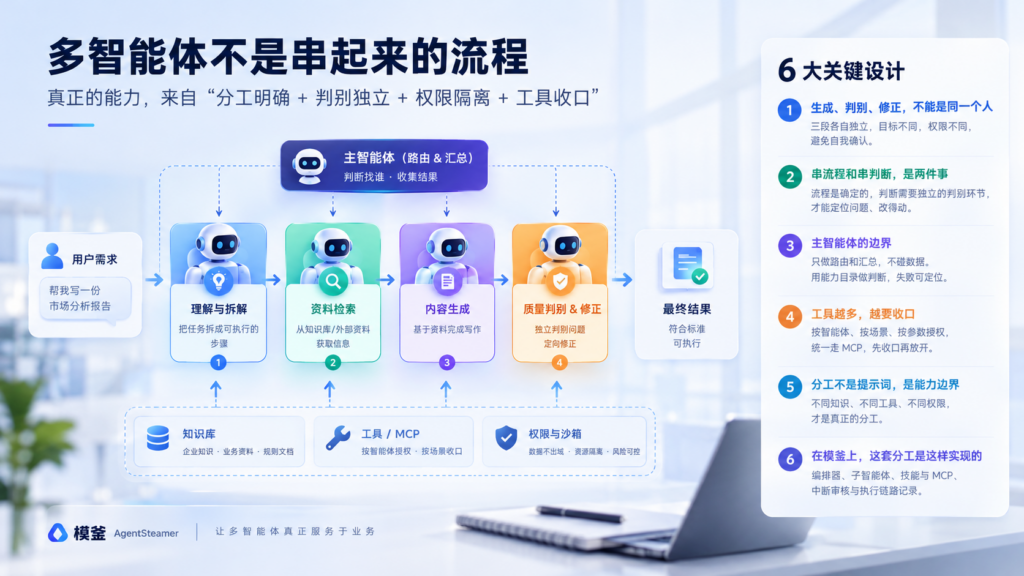
Multi-agent systems are not just chaining several agents together.
Generation, discrimination, and correction within the same context amounts to scoring yourself. The key to multi-agent systems lies not in the number of agents, but in whether these three stages each have their own clear boundaries of responsibility.

Should you deploy the agent platform in your own data center, or use someone else’s first?
Private platforms and public platforms aren’t about which is stronger—it’s about whether you’re missing the car or the garage. Three questions are basically enough to decide.

Should you grow your FDEs in-house or hire them from outside? Let’s talk straight.
Last week I had dinner with a business owner in the auto parts industry. He took a bite of food and asked me: “Everyone’s talking about FDEs these days. Do I need to go poach one from a big company? They’re asking for 800,000 a year, and that’s before stock options.”
I said, don’t rush to open your wallet just yet. Let me ask you three questions. First, when your factory is scheduling production, who can explain in one sentence how the decision is made on whether “this batch of orders can be squeezed in”? Second, that old system in your warehouse that’s been running for twelve years—do you still have the API documentation? Third, when the production line shut down for two hours last week, what was the real reason, and is the version written in the report actually correct?
He was stunned for a long moment, then said: “These… they’re all