
To determine whether an industry can be deeply AI-integrated, these 5 indicators are enough.
The previous article discussed “how enterprises can adapt to AI.” This one takes a different angle: which industries are inherently destined for deep AI-driven restructuring? This article presents a framework for assessing “AI potential” and breaks down real business scenarios and AI integration points across finance, healthcare, law, cross-border e-commerce, manufacturing, and more—helping you determine whether your industry is worth betting on.
Introduction: The Gap in AI Adoption Is Widening Across Industries
Over the past year, I’ve noticed something quite interesting: When two companies invest the same budget in AI, one sees returns in three months, while the other is still “pilot testing” after six months of struggling.
The difference often isn’t the budget or the technical team—it’s the industry’s inherent “AI affinity.”
Some industries are naturally “data-intensive, process-standardized, and labor-expensive,” so plugging in AI immediately multiplies efficiency. Others rely heavily on hands-on craftsmanship, on-the-spot judgment, and interpersonal relationships—AI can only assist, and the main battlefield still depends on people.
So rather than asking “What can AI do?”, it’s better to first ask: Does my industry have the foundation for deep AI integration?
This article is a “map of industry AI potential” for business owners.
I. Establishing the Framework: Five Indicators for Assessing AI Potential
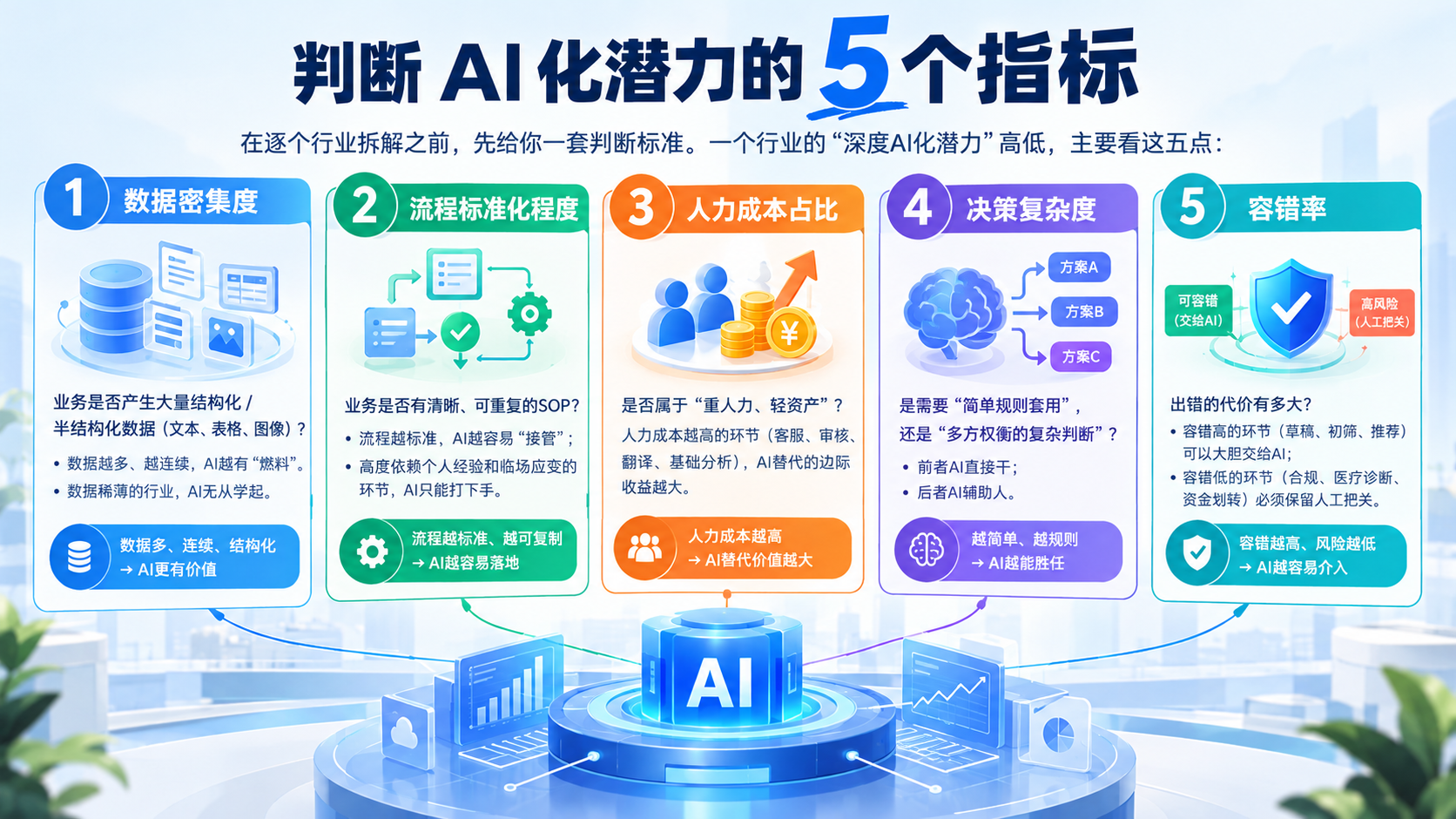
Before breaking down each industry, here’s a set of evaluation criteria. An industry’s “deep AI potential” mainly depends on these five factors:
1. Data intensity. Does the business generate large volumes of structured/semi-structured data (text, tables, images)? The more data and the more continuous it is, the more “fuel” AI has. In data-sparse industries, AI has nothing to learn from.
2. Degree of process standardization. Does the business have clear, repeatable SOPs? The more standardized the process, the easier it is for AI to “take over.” For tasks that rely heavily on personal experience and real-time improvisation, AI can only play a supporting role.
3. Labor cost ratio. Is it a “labor-heavy, asset-light” business? The higher the labor cost in a given step (customer service, review, translation, basic analysis), the greater the marginal benefit of AI replacement.
4. Decision complexity. Does it require “simple rule application” or “complex multi-party judgment”? The former can be handled directly by AI; the latter requires AI to assist humans.
5. Error tolerance. How costly are mistakes? High-tolerance steps (drafts, initial screening, recommendations) can be boldly delegated to AI; low-tolerance steps (compliance, medical diagnosis, fund transfers) must retain human oversight.
One-sentence takeaway: Plenty of data, smooth processes, expensive labor, decomposable decisions, acceptable error tolerance—the more of these five an industry satisfies, the more suited it is for deep AI integration.
Below, we use these five indicators to identify six of the most representative industries.
II. Deep Dive into Six High-Potential Industries
1. Finance / Insurance: The “Natural Fertile Ground” for AI
Business characteristics: Massive data, highly standardized processes, strict compliance requirements, and labor concentrated in middle and back offices.
Pain points: Credit review relies on manually examining documents one by one—slow and prone to oversight; insurance claims assessment and underwriting take days, resulting in poor customer experience; anti-fraud relies on rule engines that can’t keep up with new fraud tactics.
AI integration points (down to specific steps):
- Credit approval: AI automatically reads financial statements, transaction records, and credit reports to produce preliminary risk scores, with humans only reviewing “edge cases”;
- Insurance claims: Auto insurance damage assessment uses image recognition + historical claims data to provide estimates; life insurance underwriting automatically cross-references health disclosures with medical records;
- Anti-fraud: Real-time analysis of transaction behavior to identify anomalous patterns;
- Investment research / compliance: Feed announcements, research reports, and regulatory documents into a knowledge base—AI retrieves and auto-generates summaries in seconds.
Post-transformation results: Approval compressed from “days” to “hours,” with middle and back-office staff redeployed to higher-value work.
Implementation challenges: Extremely low error tolerance—must use “AI recommendation + human final review,” with extremely high requirements for data security and private deployment.
2. Healthcare: Deep Waters Entered Through “Writing Medical Records”
Business characteristics: Highly specialized, text-intensive (medical records, orders, literature), and rigorously process-driven.
Pain points: Doctors spend a huge amount of time writing medical records, entering orders, and organizing materials, leaving less time for actual consultations; diagnostic standards vary widely across primary-care hospitals; and searching the literature for medical research is enormously time-consuming.
AI entry points:
- Medical record structuring: Transcribe consultations by voice and automatically generate standardized medical records, leaving doctors only to make edits;
- Diagnostic assistance: Combine imaging recognition with a knowledge base to offer reference opinions (clearly labeled “for reference only”);
- Medical literature assistant: Researchers search vast numbers of papers in natural language, and AI automatically summarizes them;
- Patient follow-up: Scheduled tasks automatically reach out to post-surgery patients, collect feedback, and remind them of follow-up visits.
Results after transformation: Doctors’ paperwork is greatly reduced, giving time back to patients.
Implementation challenges: It involves life and health, so the tolerance for error is extremely low; AI can only be an “assistant,” not a “doctor,” and patient data privacy is a red line.
3. Legal / Compliance: An Automated Factory for Contracts and Documents
Business characteristics: Text-driven, clearly rule-based, and labor-intensive.
Pain points: Junior lawyers spend most of their time on contract review, case research, and document drafting; corporate legal teams face mountains of contracts and work inefficiently.
AI entry points:
- Contract review: AI compares clauses one by one, flags risk points and missing items, and lawyers make the final judgment;
- Case research: Describe the facts in natural language, and AI matches similar cases from a database of judicial documents;
- Document drafting: Apply templates plus key case points to automatically generate a first draft;
- Compliance checks: Add new regulatory rules to the knowledge base and automatically check whether business practices cross the line.
Results after transformation: Initial contract screening efficiency multiplies, and lawyers focus on strategy and negotiation.
Implementation challenges: Laws and regulations update quickly, so the knowledge base must be continuously maintained; AI conclusions cannot be used externally without human endorsement.
4. E-commerce / Cross-border E-commerce: The Industry Where AI Has Penetrated Most Deeply
Business characteristics: Real-time data, long process chains, operations-intensive staffing, and relatively high tolerance for error.
Pain points: Listing products requires writing huge numbers of titles and selling points; multilingual customer service is under great pressure; product selection relies on experience and guesswork; and marketing assets cannot keep up with the pace.
AI entry points:
- Product content production: Generate titles, selling points, and detail-page copy in batches, with multilingual support;
- Intelligent customer service: Automatically respond to pre-sales and after-sales inquiries 24/7, and transfer complex issues to human agents;
- Product selection and pricing: Analyze sales data and public sentiment to provide product selection and price adjustment recommendations;
- Marketing assets: Automatically generate main-image scripts, short-video storyboards, and ad copy.
Results after transformation: Launch speed, customer service response, and asset output all improve comprehensively, and operations teams shift from “manual labor” to “strategy.”
Implementation challenges: Platform rules change quickly and require continuous optimization; multilingual scenarios place high demands on content quality.
5. Manufacturing: “Hardcore AI” Starting from Quality Inspection, Production Scheduling, and Operations & Maintenance
Business characteristics: Highly standardized processes, data from production lines and sensors, and labor costs concentrated in quality inspection and scheduling.
Pain points: Quality inspection relies on the human eye, which is prone to fatigue and missed defects; production scheduling relies on experience, leading to mismatches between production and sales; and equipment failures rely on reactive maintenance, causing major downtime losses.
AI entry points:
- Intelligent quality inspection: Visual recognition automatically detects product defects and works reliably 24/7;
- Intelligent production scheduling: Automatically generates optimal production plans based on orders, inventory, and capacity;
- Predictive maintenance: Analyzes equipment sensor data to provide early fault warnings;
- Process knowledge base: Captures veteran workers’ experience into searchable knowledge so new hires can get up to speed quickly.
Results after transformation: More consistent quality inspection, more accurate scheduling, fewer downtime incidents.
Implementation challenges: Requires integration with existing production line systems; upfront investment in data collection and labeling is significant.
6. Software Development / IT: The AI “Native” Industry
Business characteristics: Fully digital, document-intensive, and decomposable processes.
Pain points: A large amount of time is spent writing boilerplate code, writing documentation, fixing bugs, and conducting reviews; the cost of translating requirements into code is high.
AI integration points:
- Code assistance: Auto-completion, function generation, and code explanation;
- Code review: Automatically flags potential defects and security risks (with final human review);
- Documentation generation: Automatically produces API docs and explanatory documents based on code and requirements;
- Requirements analysis: Organizes vague business requirements into structured documents.
Results after transformation: R&D efficiency improves, and engineers focus on architecture and core logic.
Implementation challenges: AI-generated code may contain security risks and must be reviewed by humans before deployment.
III. Beyond These Six, What Other “Next-Highest Potential” Industries Are There?
There are other industries with considerable AI potential, though their use cases are more focused:
- Education: AI grading of assignments, generating personalized exercises, intelligent Q&A, and course content production;
- Customer service / Call centers: Agent assistance, call quality inspection, and automatic ticket classification—scenarios that are almost “born for AI”;
- Logistics & supply chain: Route optimization, warehouse scheduling, document recognition, and anomaly alerts;
- Content & marketing: Automated pipelines for topic selection, scripting, voiceover, and ad copy.
What they have in common: abundant data, relatively standardized processes, and high labor costs—consistent with the framework we outlined earlier.
IV. How the Mofu Agent Platform Supports AI Implementation Across These Industries
AI integration points vary greatly across industries, but the “last mile” challenges enterprises face during implementation are highly similar. The Mofu Agent Platform’s capabilities are designed to cover these common needs:
- Orchestration of primary agents + sub-agents: An industry task often requires multi-step collaboration. For example, for an e-commerce product launch task, the primary agent can automatically dispatch “a copywriting sub-agent to write selling points, an image sub-agent to create assets, and a data sub-agent to check sales”—you just issue one command, no need to operate each one individually;
- Scheduled tasks: Insurance claim progress tracking, post-surgery patient follow-ups, competitor sentiment monitoring, daily business briefings—these “must-do daily/weekly” tasks can be handed to scheduled tasks to run automatically;
- Knowledge base / RAG retrieval augmentation: Connect your company’s product manuals, legal databases, medical record standards, and process documents to the knowledge base, so AI “checks your materials before answering,” producing output that better fits industry reality (this is also the foundation of what’s called Generative Engine Optimization, GEO);
- Persistent workspace: Project results are saved across conversations, so industry solutions and data don’t “disappear when you close the window,” and AI assets can continuously accumulate;
- Interruption confirmation: In low-fault-tolerance steps such as financial underwriting, medical recommendations, and external publishing, AI pauses at critical steps and waits for your confirmation—AI handles efficiency, humans handle risk.
Note: The above is based on publicly available product capability descriptions. Specific features are subject to official documentation. Before implementing in any industry, we recommend validating in a single scenario on a small scale first.
V. Self-Assessment Checklist: Is Your Industry or Business Ready for Deep AI Integration?
Finally, here’s a self-assessment checklist you can score item by item. The more items you check, the more you should prioritize investment:
- ☐Your business generates large volumes of text, spreadsheet, or image data every day;
- ☐You have clear, repeatable standard operating procedures (SOPs);
- ☐Labor costs account for the largest share of your operating expenses;
- ☐There are many roles or process steps that are “simple, repetitive, and low-creativity”;
- ☐The cost of errors is within an acceptable range (or human review can be built in);
- ☐Your operations are fully digitalized with system-generated audit trails;
- ☐Peers in your industry have already achieved clear results with AI;
- ☐Management is willing to invest in AI adoption and assign a dedicated person to lead it.
If you checked 5 or more items, your industry is essentially in a “high-potential zone.” We recommend starting with one use case as soon as possible to seize the advantage.
If you checked only 2–3 items, there’s no need to worry. You can start by using AI for internal efficiency gains (such as documentation, reporting, and customer service), building up your data assets along the way, and going deeper once conditions are ripe.
A final note: AI won’t transform all industries equally. It will prioritize restructuring fields that are “data-rich, process-smooth, and labor-expensive.” Reading this map isn’t about chasing trends—it’s about figuring out: Which side of the AI dividend is your industry standing on?
In your industry, which part of the workflow do you think most needs AI transformation? Feel free to share in the comments—let’s break it down together.

Related articles
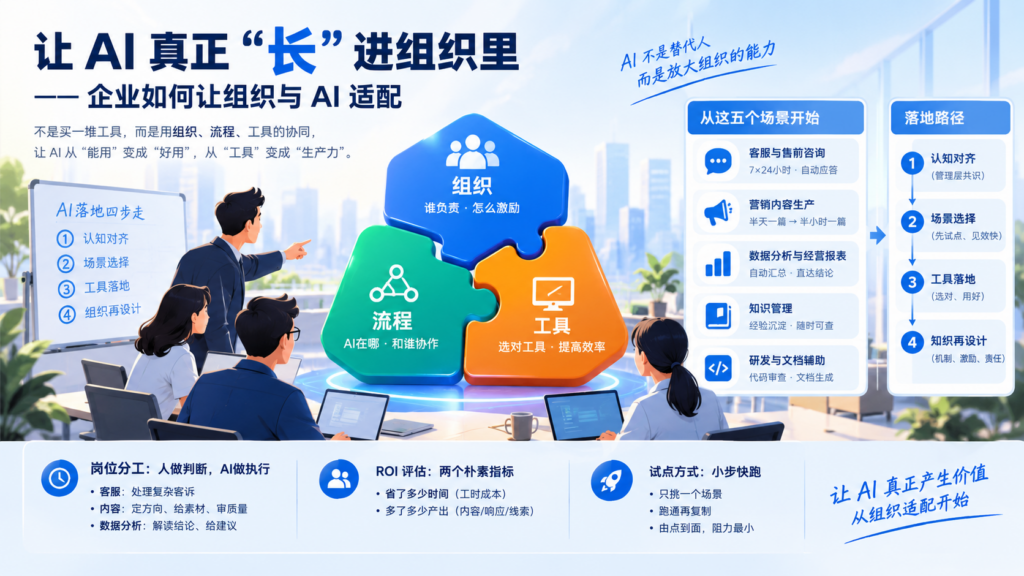
How Business Owners Can Align Their Organizations with AI in the Age of AI
> **Abstract/Introduction**: AI is here, and what worries business leaders most is not “whether to use AI,” but “why have others cut costs and boosted efficiency with it, while my team just can’t get it off the ground?” This article provides a clear framework for enterprise AI implementation: from organizational pain points and selection methods to a 30-day launch checklist, and uses the Mofu Agent Platform as an example to explain exactly how these tools should be used. — ## I. First, the Truth: Where Most Enterprises Get Stuck Over the past year, I’ve seen many business owners repeatedly agonizing over the same question: **they’ve bought a pile of AI tools, their teams have started using them, but nothing seems to have changed in the business.**
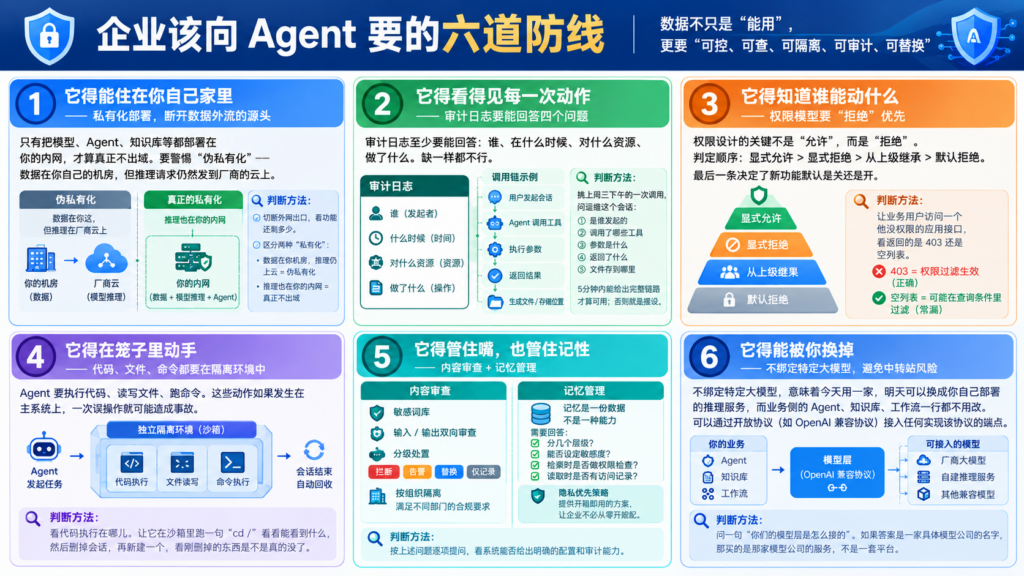
How Your Data Leaves the Company: The Six Lines of Defense Every Enterprise Agent Needs
When enterprises choose an AI Agent, the real question isn’t “will it secretly transmit data,” but “does it have the ability to transmit data, and can you see what it transmitted.” The former depends on the vendor’s integrity and can’t be written into acceptance criteria; the latter is a verifiable, auditable technical fact that can be written into a contract. Last month, during a…
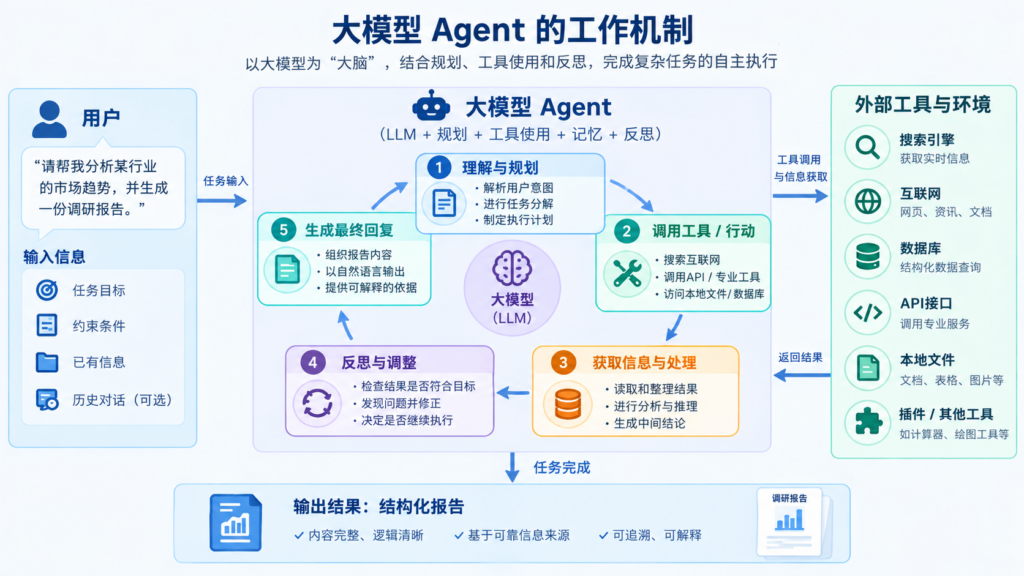
What capabilities are truly required for a genuinely usable enterprise-grade agent?
When enterprises deploy AI agents, the model is only one piece of the puzzle. This is a primer for non-technical managers: the six capabilities a truly powerful agent needs, and how AgentSteamer delivers each one.